
Where the Road Ends
A story of a Black musician, a crossroads, and the terror people later turned into myth.

Part One
Jonah Bell had been walking since noon.
The dust had stuck to him like a second skin. On his shoes, on his trouser legs, on his eyelashes, inside his mouth. Every time he spat, mud came out. His guitar hung on his back inside a black case that had split open in two places, and he had tied it with string. From far away, he looked like a man carrying the coffin of a small child.
The road outside Ashland, Mississippi, was straight, empty, and mean. Cotton fields on the right and left. Wooden fences. Signs that said things without writing them. White houses far off, like animal teeth inside the heat. A church with a peeling bell tower. A gas station that sold gasoline, coffee, and silence.
It was 1936. In the South, the year mattered less than your color. Jonah knew that before he learned to read.
His mother always said:
“Son, down here the sun has law. While it is high, you can see what is chasing you. When it goes down, the things that do not want witnesses begin.”
Now the sun was leaning.
And Jonah was alone.
He should not have been there at that hour. He had played the night before in a shack outside Lula, at a wedding that began with laughter and ended with two men shoving each other over a plate of chicken. He had been paid three dollars, half a bottle of whiskey he did not drink, and a small bag of cornbread from the bride.
In the morning, a truck driver told him he would take him as far as Clarksdale.
“If you fit in the back with the sacks, little musician.”
Jonah fit. He was used to fitting where he was told. In the backs of trucks, in kitchens, through side doors, inside other people’s lives. Somewhere halfway down the road, the truck stopped. The driver got out, spoke with two white men beside a car, came back, and did not look him in the eye.
“Get down.”
“You said as far as Clarksdale.”
“I said plenty. Get down now.”
Jonah got down. He did not ask why. Questions were a luxury for people who had the right to be displeased.
That was how he found himself on the dirt road, six hours later, his stomach empty, his throat dry, and darkness approaching without hurry.
At the first house he saw, he knocked on the door.
An old Black woman opened it just enough for one eye to appear.
“Who are you?”
“Jonah Bell, ma’am. Passing through. Looking for the road north.”
“You are passing through at a bad hour.”
“I know.”
The woman looked behind him, at the road. Then at the guitar.
“You play?”
“When they let me.”
She opened the door a little more. She was small, with a scarf around her hair and hands so thin they looked made of roots.
“I have water. A little bread. Sleep I cannot give you. I have a granddaughter inside. If anyone finds you here, we all get trouble.”
“I do not want to bring you trouble.”
The woman laughed without joy.
“Child, we were born inside trouble. We just choose who brings it to us each day.”
She brought him into the kitchen. The room smelled of beans, wood, and sweat. A little girl sat in the corner and watched him with large eyes. The woman gave him a metal cup of water. Jonah drank slowly, although he wanted to swallow all of it in one breath.
“What is your name, ma’am?”
“Ada Mae.”
“Thank you, Miss Ada.”
“Do not thank me so loud. God hears. Others hear better.”
She gave him bread wrapped in cloth.
“On the big road you will find a crossroads. Some wagons stop there. If you are lucky, someone of ours will pass before night.”
“And if nobody passes?”
Ada Mae pressed her lips together.
“Then do not stand in the middle. Do not look any white man in the eye. Do not run unless you have to. If you hear a car slowing down, get into the ditch and stay low.”
The girl in the corner said:
“Grandma, are you scared?”
Ada Mae smoothed her dress.
“No, baby. I just know what time it is.”
Jonah went back out onto the road.
The guitar on his back had grown heavier. Not from wood. From everything people believed a Black musician walking alone was carrying. Money. Women. Sins. Magic. Theft. Nerve. Everything except fear.
Nobody imagined how much fear a singing man could hold.
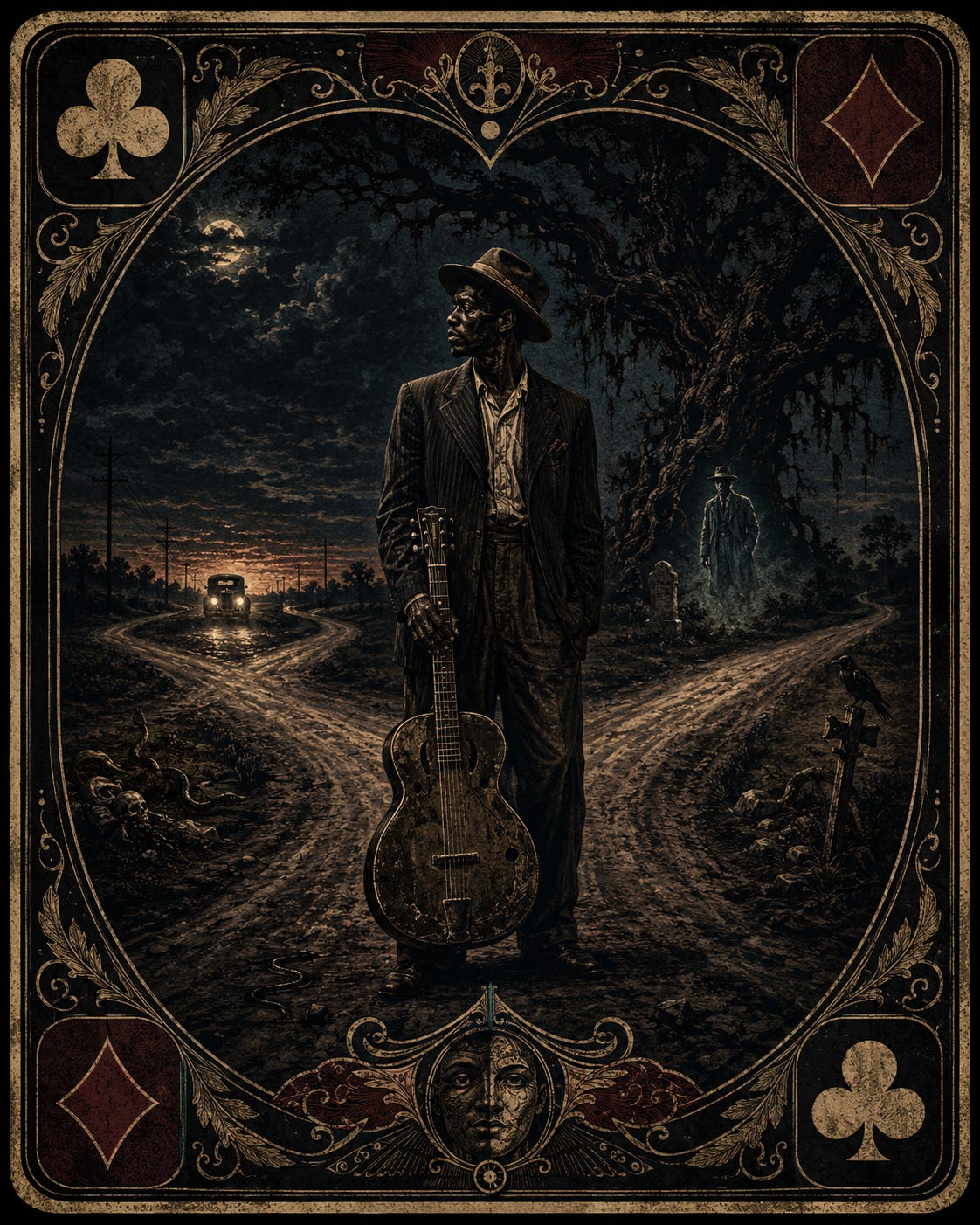
He reached the crossroads when the sky had turned the color of an old wound. Four roads. One toward the fields. One toward town. One north. One toward something that could not be seen at all.
He stood there and raised his hand at the first car that appeared.
The car passed without slowing.
The second had two men inside. One turned and looked at him. Smiled. Not properly. With that slow smile that says he has just thought of something, and the thing is not good. The car kept going.
Jonah felt the sweat go cold under his shirt.
Farther away, under an oak tree, an old man was sitting with a straw hat. Jonah had not seen him before. He had a cane between his knees and polished shoes, out of place in the mud of the road.
“Waiting for someone?” said the old man.
Jonah turned sharply.
“I am waiting for whoever is going north.”
“Everybody says north when they do not want to say far away.”
Jonah did not answer.
The old man pointed at the guitar.
“You play well?”
“Well enough to eat. Not well enough to stop being hungry.”
The old man laughed. His laugh was dry.
“Then you play true.”
Jonah looked at him more carefully. He did not look like a farmer. He did not look like a preacher. He did not look like a beggar. He was simply there, as if the road had pulled him out of the dirt.
“Where did you come from?” Jonah asked.
“From where everybody goes when they think they are leaving.”
“I have no money.”
“I did not ask.”
“I have nothing to give.”
The old man lifted his eyes. They were calm. That was the frightening part.
“Everybody gives something. Some only learn the price later.”
Jonah felt his stomach tighten.
“I am not looking for those kinds of things.”
“What things?”
“You know.”
The old man tapped the cane on the dirt.
“People say many things about crossroads. They say if you stand here at the wrong hour, you can get talent, luck, women, money, a voice that makes others remember their dead. They say someone comes and asks you for something you cannot see.”
“I am only asking not to be caught here by night.”
“That is what everyone asks at first.”
Far away, an engine sounded.
Jonah turned. Lights. A car. Slow.
The old man said quietly:
“Do not raise your hand for that one.”
Jonah froze.
“Why?”
“Because those men do not stop to pick up a person. They stop to find a reason.”
The car came closer. Three white men. Hats. Cigarettes. One held a bottle. The vehicle slowed.
Jonah heard his heart in his throat.
“Hey, you!” the driver shouted. “What are you doing here at this hour?”
The old man had vanished.
Not walked away. Not hidden.
Vanished.
Jonah had no time to be afraid of that. He had another fear in front of him, more ordinary, more human, and therefore worse.
“Passing through, sir.”
“Passing through? From where?”
“From Lula. Going north.”
The man beside the driver leaned out of the window.
“What do you have on your back?”
“A guitar, sir.”
“A guitar? Play us something.”
The third one laughed.
“Yes, play. Let us see if you are worth leaving on the road.”
Jonah understood that night had already arrived, even though there was still light in the sky.
Part Two
He took out the guitar slowly.
His hands were shaking. He tried to make them look tired, not frightened. Frightened people draw blood from those who want to feel strong.
“Quick,” said the driver.
Jonah slipped the strap over his shoulder and struck a string. It was a little out of tune from the damp. He turned the peg. Then he played.
He did not play a song they knew. He did not play anything for dancing. He played something he had made while walking that day. Bass with the thumb, a small melody above it, as if two people were talking inside the same body. One was saying run. The other was saying stay alive.
The men stopped laughing.
That was dangerous.
A white man could tolerate finding you entertaining. Finding you sad. Finding you useful. Finding you good at something, really good, could become an insult without your even opening your mouth.
Jonah lowered his eyes.
The man with the bottle said:
“Where did you learn to play like that?”
“From people better than me, sir.”
“Who?”
“My uncle. An old musician in Greenville.”
“Lies.”
Jonah stopped playing.
“No, sir.”
The driver got out of the car. He was tall, with a belly hanging over his belt and a round face like a ball. He came so close that Jonah smelled smoke, sweat, and sour whiskey.
“They say some of yours learn things like that in strange places.”
Jonah held the guitar in front of him. Not like a weapon. Like a fence.
“I learned through work.”
The man smiled.
“Work?”
The others laughed now.
“You hear that? He is talking to us about work.”
Jonah swallowed.
“I have to leave before dark.”
The laughter stopped.
The driver looked at him. It was the wrong thing to say. The fear had shown.
“And what happens if it gets dark?”
No one answered. Everyone knew.
Then a wagon sounded from the road by the fields. A Black man was driving two mules, with a boy beside him. The man saw the car, saw Jonah, and understood at once. In the South, understanding was quick because survival left no time for slow thought.
“Evening,” said the man on the wagon, carefully.
The driver turned.
“You know this one?”
The man on the wagon looked at Jonah for only a second.
“Yes, sir. He is my wife’s cousin. We were expecting him.”
Jonah felt the strength leave his legs.
The driver narrowed his eyes.
“Cousin, huh?”
“Yes, sir.”
“What is his name?”
The man on the wagon said:
“Samuel.”
Jonah did not move.
The driver turned toward him.
“That your name?”
Jonah felt time split in two.
“Yes, sir.”
The driver stared at him.
The boy on the wagon had become a statue.
The man with the bottle shouted:
“Let them go. I am hungry.”
The decision of a drunken body saved him. That was how cheap some lives were. Hanging from another man’s hunger.
The driver spat in the dirt.
“Take him out of here.”
Jonah climbed onto the wagon without looking back. The man urged the mules forward. For ten minutes, nobody spoke. Only the wheels creaked and the insects began their evening song, indifferent to salvation.
Finally, the man said:
“Your name is not Samuel.”
“No.”
“Good. I do not care either.”
“I owe you my life.”
“Do not say big words on the road. The road gets jealous.”
The boy turned.
“Do you really play that well?”
His father said:
“Do not ask.”
Jonah looked at his hands. They were still shaking.
“I play well enough to have trouble.”
The man left him at a Black settlement three miles farther on. Small houses, smoke from kitchens, children running barefoot, women coming back from washing other people’s white clothes. They took him to a house where a heavy woman with a laugh strong as a bell put a plate of beans in front of him.
“Eat, musician. You look like the devil chewed you and did not like the taste.”
Jonah almost laughed. It did not come out.
That night, they had him sleep on the floor between two snoring boys. He did not sleep. Every time he closed his eyes, he saw the car. The lights. The smile. The old man under the oak tree.
In the morning, he played in the yard for those who had gathered. Not for money. To give thanks. The music came out different. More broken. Deeper. Something had entered his hands during the night, not demonic, not miraculous. Fear. When fear passes through the body and does not kill you, it leaves rhythm.
A woman crossed herself.
A man said:
“He did not learn that by himself.”
Jonah lifted his head.
“Pardon?”
The man, young, handsome, with envy already ripe inside him, smiled.
“I am saying that playing like that has a story.”
The heavy woman who had fed him struck her spoon against the table.
“Everything has a story. Corn has a story if you ask it right. Let the man play.”
But the seed had fallen.
By noon, two children were saying that Jonah Bell had stood at the crossroads at night and spoken with someone who did not look normal.
By afternoon, a woman was saying she saw his shadow go east while he went west.
By the next week, in another village, a bartender was saying Jonah had sold something in the dark and gotten back hands that were not his.
He had sold nothing.
He had only knelt inside himself and begged to live.
Nobody wanted that story.
It was too simple. Too ugly. Too real.
The myth was more convenient.
The myth said Jonah had met the Devil. That way people did not have to say he had met three white men on a Mississippi road. The myth said he had paid with his soul to play like that. That way they did not have to say a Black man could become great on his own, from hunger, work, memory, ear, pain, and despair.
The myth cleaned the blood from the story.
Jonah kept playing.
In shacks, kitchens, back rooms, yards, weddings, funerals, places where the floor stuck with beer and the windows sweated from bodies. People listened to him and fell silent. Some cried against their will. Some grew angry. His music did not exactly comfort. It told the truth in a way that made comfort look a little ridiculous.
Once, in a juke joint outside Vicksburg, a drunk man asked him:
“Is it true?”
Jonah was tuning the guitar.
“What?”
“That you gave your soul.”
Jonah looked around. Smoke. Sweaty people. Cheap drink. A woman at the edge holding her sleeping baby in her arms. A man with a blackened eye. A child outside the window trying to listen without paying.
“No,” he said.
The drunk man looked disappointed.
“Then how do you play like that?”
Jonah bent over the guitar.
“I stayed alive one night when I was not supposed to.”
The man did not understand. Or maybe he did not want to.
“That is not a good story.”
Jonah smiled for the first time that day.
“Good stories are for people who have time to decorate them.”
He played.
And as he played, he remembered the crossroads. Not as legend. As place. The dust under his knees. The lights of the car. The disappearance of the old man. The lie of a stranger who made him family in order to save him. The night coming down on him like a hand.
Later, people would make the story more beautiful and darker. They would put in a devil, midnight, bargains, black dogs, hands that changed owners. They would say Jonah Bell went to the crossroads and came back different.
In that, they would be right.
Only it was not the Devil who changed him.
It was terror.
It was the moment he understood that his life could end for no reason, with no justification, with no one punished, without even his name being said correctly.
It was the fact that he came back from there.
In winter, months later, Jonah passed again along a nearby road. He did not go to the same crossroads. He was not a coward. He was not an idiot either. He stopped at an inn for Black travelers, ate soup, and that night sat close to the stove.
A young musician approached him.
“Mr. Bell?”
Jonah looked up.
“The mister is the owner here. I am the one who still owes for the soup.”
The boy laughed awkwardly.
“I want to play like you.”
“No, you do not.”
“I do.”
Jonah looked at the boy’s hands. Clean. Nervous. Hungry for glory, not yet for survival.
“Then learn to listen to people when they are not speaking. Learn how heavy a door sounds when it closes. How slowly a frightened father breathes. How high a woman laughs when she wants not to cry. Learn those things. The guitar will tell you the rest later.”
The boy nodded, without fully understanding.
“And the crossroads?”
Jonah went still.
“What about it?”
“They say that is where you learn the secrets.”
The stove made a small metallic sound.
Jonah said:
“At the crossroads you do not learn secrets. You learn whether you want badly enough to live.”
The boy lowered his head.
“And if you do not?”
Jonah looked out the window. The road was dark. Somewhere far away, a dog barked. For a moment, he saw the old man under the oak again, or thought he did, because fear has that bad habit. It knows how to return with a stranger’s face.
“Then,” he said slowly, “you play until you want to.”
The boy stayed with him until late. They did not talk much. Jonah showed him a turn with the thumb, a way to let the low string walk while the others cried above it. The boy struggled. Got angry. Tried again.
“It will take time,” he said.
“Everything worth anything takes time,” Jonah said. “And some things that are not worth it take a lifetime.”
When he was alone, he took a piece of cloth from his pocket. It was from the bread Ada Mae had given him that day. He still kept it. He did not know why. Maybe because that woman had looked at him like a human being before the road tried to turn him into a ghost.
He placed it on the guitar.
“Thank you,” he said quietly.
He did not know whether he was speaking to Ada Mae, to the stranger with the wagon, to God, to the road, or to that piece of himself that had not knelt to surrender, only to rise again.
Outside, the night continued.
The South continued.
The roads continued splitting.
And somewhere, at some other dark crossroads, another man would raise his hand to stop someone who might save him or kill him.
That was the real song.
Not the Devil.
Not the bargain.
Not the fantasy of those who prefer evil to wear horns, so they do not have to recognize its face.
The real song was a man alone on the road, just before nightfall, with a guitar on his back and the whole world against him.
A man who only wanted to pass through.
A man who later played as if he had met something supernatural.
And maybe he had.
Not a demon.
The clear, naked terror of human life when no one comes to protect you.
That is where the music came from.
That is where the myth came from.
That is where Jonah Bell came from, still walking, while behind him the sun fell and the road pretended it remembered nothing.
Hmmm..... hard to rise above emotion
There is something heartbreaking about the idea that people wanted a supernatural explanation because the real explanation said too much about the world they lived in 💔 beautifully written ❤️