

There are places where the air never truly clears, because even when the explosions stop, the smell of smoke remains on the people who survive them. The day begins with sirens, dust, the taste of metal, and a scream you did not make yourself but that, for someone else, was the first sound of the morning.
Somewhere, a mother digs with her bare hands because the machines have not arrived yet. Somewhere, a child who until yesterday had a name, a favourite meal, toys, and someone reminding them to put on a jacket becomes a number within a few hours. The number enters a caption, passes across our screens, and is eventually replaced by the next one.
We continue with our day. We eat, work, drive, answer messages. Somewhere between an advertisement, a cat video and an argument between strangers online, a destroyed house appears. Then a stretcher. Then the face of a child covered in dust.
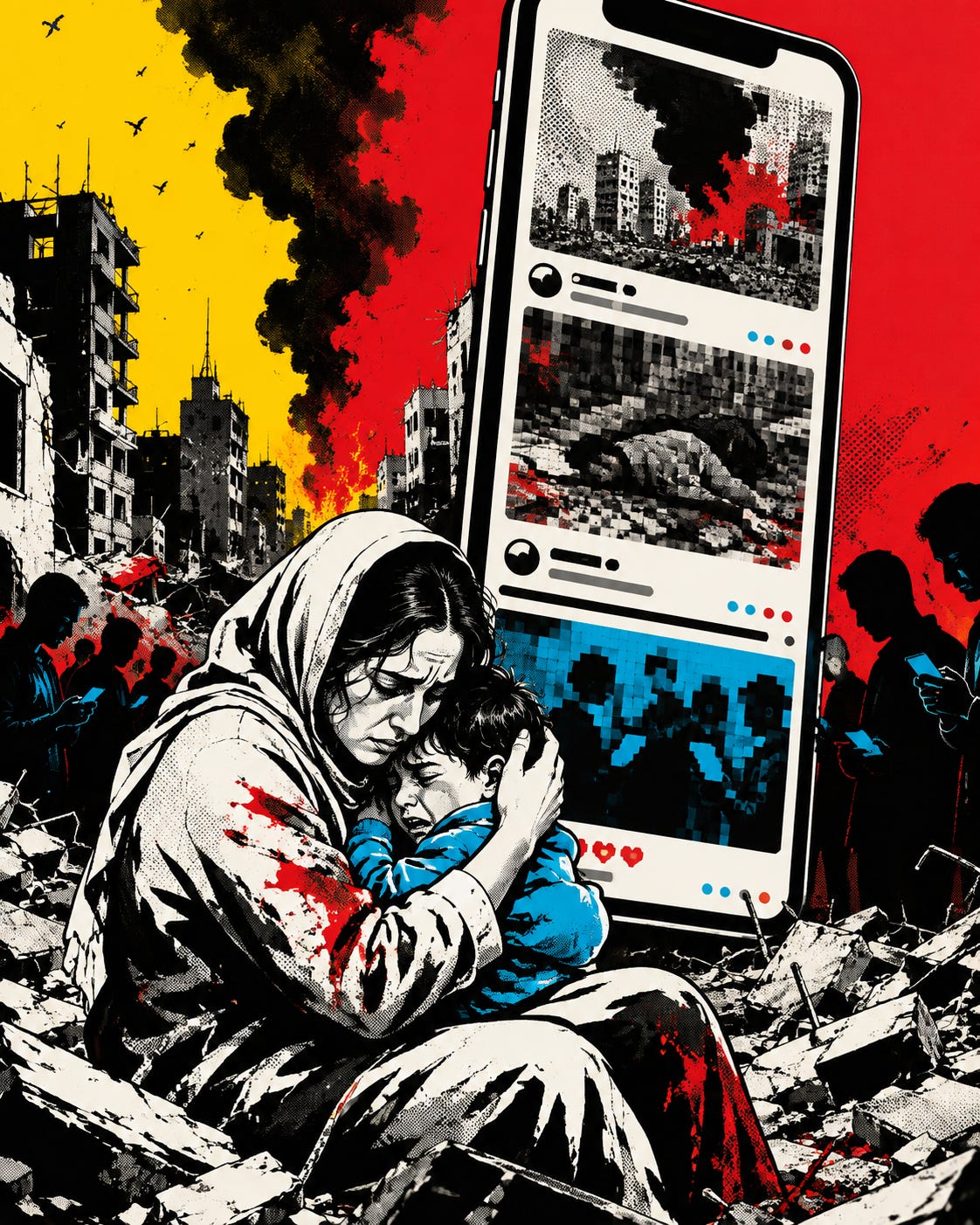
The blood becomes pixels, and perhaps that is one of the strangest forms of violence in our time: not that we see horror, but that we see it so often that eventually we learn how to move past it.
This does not happen because we are all indifferent or cruel. The human mind cannot live permanently in a state of alarm. It protects itself, closes doors, lowers the volume and turns things that might once have haunted us into just another image in an endless stream.
But there is a point where self-protection begins to look dangerously like acceptance, and language helps us reach it.
A bombing becomes an “operation.” The dead become “casualties.” A destroyed city block becomes a “target.” The people inside it become “collateral damage,” a phrase so clean and technical that it seems almost incapable of leaving blood behind.
There are other words too: “security,” “retaliation,” “deterrence,” “strategic necessity.” They can have specific meanings in the language of politics and war, but when they are repeated without returning to the human result, they begin to work like detergent for the conscience, cleaning the scene before we have truly looked at it.
That does not mean every conflict is the same, or that attackers and defenders, responsibility, history, competing interests and genuine dilemmas do not exist. They do. And precisely because they do, it becomes even more important not to lose the human being inside the language we use to explain them.
Because behind every “strategy” there is always someone who will pay for that strategy with their body, and it is rarely the person who designed it.
Once, images of war arrived slowly. A photographer returned, film was developed, a newspaper printed a photograph capable of changing the public conversation. Today, horror can be transmitted almost live. We sometimes see what happened before the people inside the image have even understood it themselves.
Yet immediacy has not necessarily made us more present. Sometimes it has simply made us faster: faster to comment, faster to choose a side, faster to declare an opinion, and much faster to move on to whatever comes next.
Tragedy now enters the logic of the feed. It arrives, rises, peaks, becomes exhausting and then falls away. The people under the rubble, however, have no algorithm that allows them to change the subject once we have scrolled past.
For them, the image continues after we are already looking at something else.
Sometimes, though, one image refuses to leave. A small body beneath concrete. A face half-covered in dust. A hand emerging from what used to be a room. A father holding something no parent should ever have to hold.
For a few seconds, the distance collapses. You are no longer looking at “the situation.” You are looking at a human being.
And perhaps that is the most important thing repetition is constantly trying to take from us: the ability to understand that every person in those images had an entire life before becoming an image.
Every generation wants to believe it has learned from the generation before it. We look at old photographs of wars, ruined cities and dead civilians and wonder how any of it could have been allowed to happen.
Then new uniforms appear, new flags, new justifications and new graves. Technology changes, the language becomes more sophisticated, the presentations become cleaner, the maps interactive, and the weapons acquire names that sound almost surgical.
The result remains disturbingly old. One human being kills another, and somewhere a child learns far too early what a building sounds like when it collapses.
The most dangerous thing is not that humanity learned the language of violence. We have always known it. The most dangerous thing is that we have learned how to hear it without interrupting whatever else we happen to be doing.
Perhaps we cannot stop every war. Perhaps we have no influence over decisions made thousands of kilometres away. But there is still something we can refuse: turning human beings into background.
We can refuse to let the number completely replace the name, to let technical language erase the body, or to treat the image of a dead child as something requiring one more comment before we continue with the day.
Because behind every “operation,” every “retaliation,” every “strategic target” and every arrow drawn across a map, there is ultimately something far less complicated.
There is a human being who wants to live, and very often there is a child with blood on their face who knows nothing about the words adults will later use to explain why they ended up there.
If that image can still disturb us, then something inside us is still resisting. If one day it no longer makes us feel even briefly sick, then perhaps we will not need to wait for war to reach our doorstep.
It will already have reached us from within.
Written with care..
I feel it ..
The repetition of war images can dull our senses, but we must resist this. Each image tells a story of loss and resilience.