

We Mistook Communication for Management
We call it communication because the word sounds human. Most of the time, it is only distance with good punctuation.

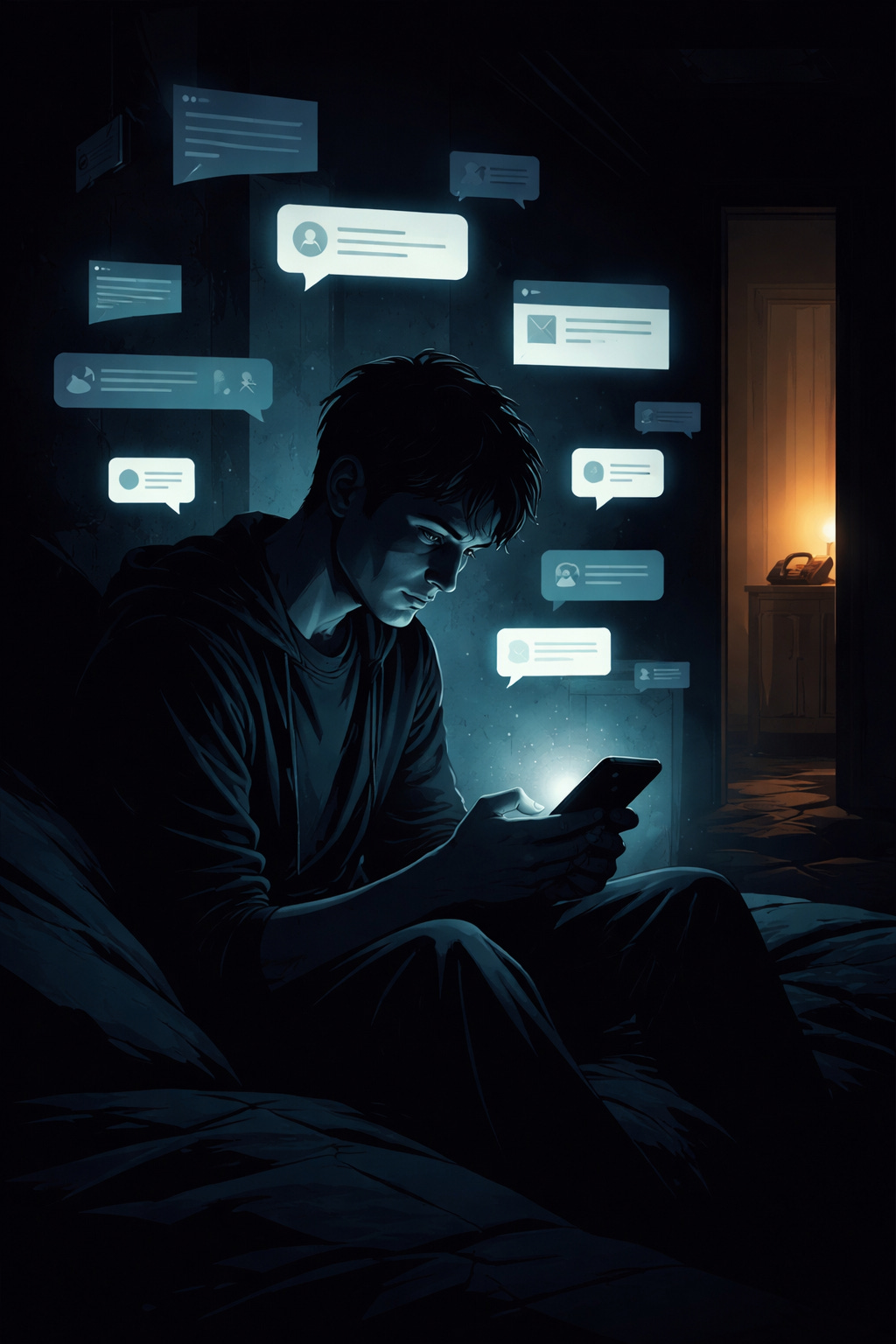
Our era has a sickness, and we renamed it progress so we would not have to feel ashamed.
We say we communicate more than ever. In reality, we throw signs of life at one another and pretend that counts as relationship.
A message.
A reaction.
A “happy birthday” glued onto a ready-made gif.
A “let’s see” that means no.
A “sorry for the late reply” that means you were never important enough to exist first in my day.
We call that communication.
It isn’t.
It is people management.
The word, in its old root, meant something else. It meant sharing. A common space. A relation built between two sides, not information thrown from one side to the other like proof of delivery. To communicate once meant I step out of my shell and I meet you. Now it means notification. Screen. Keyboard. Three dots blinking, and then nothing.
The problem is not written messages themselves. They are useful. For time, for place, for reminders, for “I arrived,” for “send me the file,” for “I’ll be ten minutes late.” They do that job just fine. The problem begins when we ask them to carry weight that does not belong to them. Apology. Grief. Disappointment. Rejection. Love. Anger. Hesitation. That is where the thing starts to rot.
Because meaning does not live in words alone. It lives in tone. In the space between words. In how quickly you take a breath before answering. In whether the voice cracks a little when you say someone’s name. In whether exhaustion, shame, awkwardness, care, anger trying not to become violence can be heard. Writing kills or impoverishes all of that. It flattens it. Dries it out. Makes it neutral, safe, polished.
And our age worships exactly that. The safe. The controlled. The editable. The erase-and-rewrite before I expose myself. The send-and-disappear. The say-it-without-you-hearing-me-say-it. The avoid-it-and-call-it-civility.
That is where the great loss is.
We did not only lose the art of conversation. We lost the ability to endure presence.
We no longer want to step into voices that might put us in an uncomfortable position. We do not want pauses we cannot control. We do not want silences that force us to remain inside the moment without an escape button. We do not want to hear disappointment in a real throat, because then we would have to admit that there is a human being in front of us and not a recipient.
Writing suits us because it protects us from the living consequence of ourselves.
You can cancel someone by email.
You can end a relationship by text.
You can let a friend fade inside reactions and half-replies.
You can say “I love you” without enduring the look that will follow.
You can say “I’m sorry” without anyone hearing your shame.
And the more we do it, the weaker the muscle of real contact becomes.
Let me say it plainly.
We have become brave only on the keyboard.
That is where we become clear, comfortable, well-phrased. That is where we know exactly what we want to say. That is where the palm does not sweat, the voice does not tremble, the image we have of ourselves is not put at risk. The screen grants us something that real contact never grants. Distance from the cost.
But without cost, there is no real relationship.
There is only an exchange of signals.
A few months ago, a company booked me for a talk. Everything had been arranged. Topic, schedule, meetings, timings. I had moved things around in my life in order to be available. I had even cancelled a small trip with my daughter. Three days before, an email arrived.
Polite. Clean. Tidy. Dead.
“Unfortunately, we will need to cancel the talk.”
That was all.
I did not get angry because it was cancelled. Cancellations happen. Life destroys plans every day. I got angry at the other thing. At the void inside the manner. At the absence of presence. At the fact that someone sat down, wrote a correct message, hit send, and imagined that this was enough to complete the human side of a disappointment.
It is not enough.
I called. Not to shout. Not to demand explanations. I called to say something simple. That when you choose the safe distance of an email for something that truly affects a human being, you lose what matters. You lose the possibility for understanding to exist. Because understanding is not built out of information alone. It is built out of presence.
If you call me, I hear whether you are embarrassed.
I hear whether you are in a hurry to get it over with.
I hear whether it costs you something.
I hear whether you respect me.
And you hear what your action does when it lands on a real human being.
In email all of that gets buried. Only the fact remains. Dry. Cold. Managed.
And that is how we live now. Managed.
Birthdays through stories instead of voices.
Condolences through text.
Arguments through bubbles.
Relationships dissolving into “seen.”
Cancellations through templates.
Friendships that never exactly ended, they just thinned out through small absences until nothing was left.
The most insidious part is that all of this looks normal. Functional. Efficient. Nobody shouts, nobody exposes themselves, nobody takes on the awkward weight of a real moment. Everything flows. And precisely for that reason, everything rots.
Because real communication is not efficient.
It is slow.
It is clumsy.
It has pauses.
It has misunderstandings.
It has looks that unsettle you.
It has silences you cannot hide under proper punctuation.
And that is why it is real.
Oh I love this! This piece really hits home. It’s so true how we’ve replaced genuine connection with digital interactions. We need to remember that real communication takes time and effort, but it’s worth it.😊
You're right. I miss phone calls. Not many people want to talk anymore. Some people, many people, think it's weird, improper, to call without scheduling the phone call. They say, "Who calls anymore?" as if you're a freak. What happened to us?