
The Name Behind the Mirror
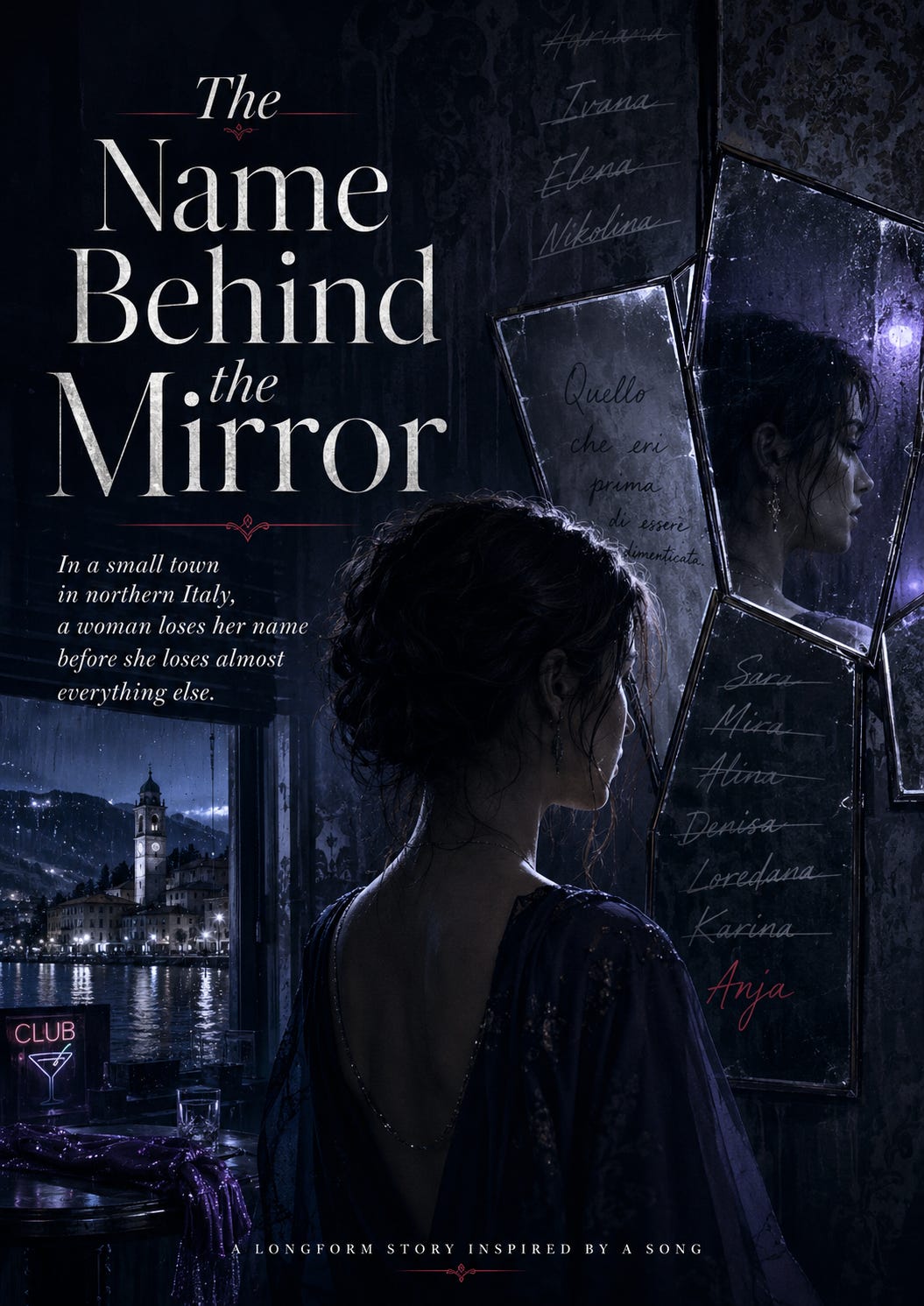
In a small town in northern Italy, a woman loses her name before she loses almost everything else. What nobody notices is that every night, somewhere out of sight, she writes it back.

Part One
The first night Iryna Kovalenko arrived in San Rocco del Friuli, a man wearing a gold cross decided that her name was wrong. It was November 2004, and the thin rain of northern Italy seemed less to fall from the sky than to live permanently inside the air. Luca Bellandi stood at the back entrance of the Luna Blu with a cigarette in one hand and a heavy ring of keys in the other.
“Iryna?” he asked. She nodded, and he tried the name once more, slowly, as though testing food he already suspected he would dislike. Then he frowned and said it sounded too Eastern.
“I’m from Ukraine,” she replied.
“Exactly.”
He led her through the club. Purple lights washed over gold curtains, red imitation-leather sofas and mirrors positioned everywhere a mirror could possibly fit. Above the bar hung a fake crystal chandelier trying so desperately to look expensive that it had achieved something closer to menace.
Luca pointed around the room as if he were showing her an apartment she might rent.
“Here, you’ll be Maria.”
“My name isn’t Maria.”
He smiled.
“Here it is.”
Iryna was twenty-seven and had studied accounting in Dnipro. She could read balance sheets, find irregularities in invoices and divide large numbers in her head faster than most people could find the calculator on their phones. None of these qualifications had appeared particularly useful during the previous eleven days.
She had left Ukraine after answering an advertisement for restaurant work near Trieste. Eight hundred euros a month, accommodation included, legal papers arranged. At the border, a man had taken her passport “for processing.” In Trieste, another man explained that she already owed four thousand euros for transport, documents and housing.
Then she met Luca Bellandi.
In San Rocco, people described Luca as “a difficult man,” the phrase small communities use when the accurate noun would make everyone uncomfortable. He was forty-two, wore his black hair combed carefully backward and drove a Mercedes SLK that cost more than most of his employees earned in a year.
He called the car an investment. Nobody had ever been impolite enough to ask what exactly it was expected to produce.
Every Sunday Luca sat in the third row at the Church of Sant’Andrea. Never the first row, because that belonged to genuinely wealthy families, and Luca was unusually sensitive to social geography. He donated money to the parish, paid for the Christmas lunch for elderly residents and had financed the new changing rooms for the local children’s football team.
A plaque beside the entrance read:
Donated by Bellandi Trasporti. For the children of our community.
Bellandi Trasporti owned two trucks. One had not moved in eighteen months.
The Luna Blu employed thirteen women.
San Rocco was a town that preferred not to do arithmetic.
Mara Rinaldi arrived at the club every morning at six. She was fifty-nine, widowed, broad-shouldered and possessed the exhausted expression of someone who had spent most of her life listening to nonsense without ever becoming entirely immune to it.
She cleaned glasses, cigarette ash, vomit, lipstick from collars and whatever remained of married men’s dignity after they had misplaced it somewhere during the night. She maintained that men were the only animals capable of spending a hundred euros doing something and then spending two hours explaining that they had never done it.
Mara met Iryna on her third morning.
She entered room four without knocking, noticed the bruises on Iryna’s arm and made no comment. She opened the window, stripped the bed and left a cup of coffee beside her.
“Maria?”
Iryna looked up.
“Iryna.”
Mara paused for half a second.
“All right. Iryna.”
She was the first person in Italy who had accepted the correction without demanding an explanation.
Two weeks later Mara found the first name.
She had removed the mirror in room four to clean behind it and saw pencil marks on the plaster.
IRYNA KOVALENKO
17.11.2004
Mara stared at it for a while, then put the mirror back.
The following week she found the same name underneath a drawer. Later it appeared behind a cheap framed print, then inside a cupboard where the clean towels were kept. Once she found it written beneath the lid of a toilet cistern.
She never asked Iryna why.
Some questions are insulting because the answer is already obvious.
San Rocco had sixteen thousand residents, three banks, seven churches and twenty-two bars. It also possessed an extraordinary collective ability not to notice anything that might require moral inconvenience.
Mayor Alberto Bertani had been elected under the slogan “Family, Security, Work.” Every Friday night he entered the Luna Blu through the rear door.
The local police commander, Carlo Vezzi, had once told a regional newspaper that illegal migration threatened the social fabric of Italy. Luca paid his daughter’s private-school fees.
Father Ernesto had preached twice that year against moral decline. When Luca donated three thousand euros toward a new heating system for the church, Father Ernesto thanked him publicly during Mass.
Apparently heaven had utility bills too.
Iryna began working in Luca’s office by accident.
One Monday afternoon she heard him shouting because his accounts would not reconcile. His accountant had entered the same payment twice, but Luca had spent twenty minutes accusing the computer of incompetence.
Iryna stood in the doorway.
“You entered that invoice twice.”
Luca turned around.
“What?”
She stepped over, pointed at the screen and found four more errors within three minutes. For the first time since her arrival, Luca looked at her not as a body but as a useful instrument.
It was almost worse.
From then on, he summoned her to the office every Monday. That was how Iryna discovered that Luca kept two sets of books. One belonged to the Italian state. The other belonged to reality.
The second contained names.
Politicians, police officers, businessmen, customs officials. Beside the names were amounts. Sometimes there was only an initial, a date and a number plate.
Luca believed Iryna understood very little Italian.
Iryna considered this one of his more charming mistakes.
By February 2005, she had started copying information.
Never onto paper. She kept a small ledger in her head, three numbers at a time, then a name, then a date. Later she would write them behind the mirror in room four and erase them the following morning after memorising the next group.
One morning Mara caught her halfway through the ritual.
“What are you doing?”
“Remembering.”
“What?”
Iryna looked at the figures on the wall.
“What they need everyone else to forget.”
That same month, a Moldovan woman called Anca disappeared.
Luca said she had left with a customer. The other women said nothing, because silence at the Luna Blu was less a choice than a working condition.
Three days later, Mara found Anca’s winter coat in a storage room.
She said nothing about that either.
Mara had been practising silence for twenty years.
Her husband Paolo had worked for customs. Before cancer killed him, he admitted that for years he had allowed certain trucks to pass without inspection. Cigarettes first, then alcohol, later things he refused to describe clearly.
Once, very late in their marriage, he admitted that some trucks had carried people.
“I didn’t know exactly what was happening,” he told Mara.
She asked how much money he had accepted for something he did not know was happening.
Paolo never answered.
A year after his death, Mara read that the body of a nineteen-year-old Romanian woman had been found outside Gorizia. She had spent weeks wondering whether the girl had crossed the border in one of the trucks Paolo had waved through.
She never discovered the answer.
Since then Mara had developed a particular hatred for the sentence I didn’t know.
In April, Iryna made her first serious mistake.
She asked Luca what had happened to Anca.
His face barely changed. That frightened her more than shouting would have. Truly dangerous men rarely need theatre.
“She left.”
“Her coat is still here.”
“And?”
“It was February.”
Luca stood.
“Are you my accountant now?”
“I was an accountant before I met you.”
The blow came so quickly that Iryna never remembered seeing his hand move. What she remembered was the floor, the metallic taste of blood and the strange quiet afterward.
Two teeth had broken.
Luca looked at the blood on his shirt with more irritation than he showed toward her injury.
“Look what you made me do.”
Later, Mara sat beside Iryna on the bed holding a bag of ice against her mouth.
“You have to leave.”
Iryna laughed, then winced.
“Excellent idea.”
“I’m serious.”
“So am I.”
That night Mara told her about Paolo for the first time. She told her about the trucks, the envelopes, the customs officers who looked the other way and the Romanian girl whose face she had seen only in a newspaper photograph.
“I don’t know whether Paolo ever saw her,” Mara said.
“But you’re afraid he did.”
“Yes.”
They sat quietly for a while. Outside, a delivery van reversed into the courtyard, beeping mechanically into the darkness.
Then Mara said, “I know a road.”
Part Two
The old customs track began north of San Rocco, passed through vineyards and abandoned farm buildings, then disappeared into woodland near the Slovenian border. Paolo had used it during the early 1990s, when the Balkan wars had transformed every crossing in the region into a small stock exchange where fear was traded for cash.
Mara still had one of his maps.
“This takes you to an abandoned railway tunnel,” she said, running her finger along a faded line. “On the other side, you’re in Slovenia.”
“And then?”
Mara shrugged.
“Then you’re in Slovenia.”
“And after that?”
“I clean a nightclub, Iryna. I’m not a travel agency.”
For the first time since Luca broke her teeth, Iryna laughed properly.
The plan could have been simple.
It was not, because Iryna did not only want to escape. She wanted Luca’s black ledger.
Mara called her insane.
“That isn’t an escape plan. That’s a request for a funeral.”
Iryna ran her tongue across the gap where a tooth had been.
“If I leave without it, he’ll bring another woman here.”
“He’ll bring another woman anyway.”
“Maybe. But if somebody has that ledger, perhaps one day someone can stop him.”
Mara studied her.
“You still believe in things like that?”
“No.”
“Then why do it?”
Iryna gave a tired smile.
“You don’t have to believe something will work before you decide it should be attempted.”
They chose May 18.
That evening Luca was attending a dinner hosted by the Regional Association of Entrepreneurs, where he was receiving an award for “his contribution to local economic development.”
Mara found the invitation in his office and had to sit down because she was laughing too hard.
“There may actually be a God.”
“I thought you didn’t believe in God.”
“I don’t. But whoever is running this place has a sense of humour.”
At nine ten Luca left the Luna Blu wearing his best suit and enough cologne to register as an environmental event.
At nine forty Iryna entered his office.
She knew the combination to the safe.
His mother’s date of birth.
Men who consider themselves criminal masterminds frequently use passwords designed by eight-year-olds.
Inside were twenty-seven thousand euros, two passports, a handgun and the black ledger.
Iryna took the ledger first.
Then she stared at the money.
She counted eleven thousand euros and put it into her bag.
Months later Mara would ask why she had taken precisely eleven.
“Because that’s what he owed me.”
“How did you calculate it?”
“I’m an accountant.”
At ten fifteen, a customer arrived whom nobody expected.
Police commander Carlo Vezzi had argued with his wife and decided that the obvious response to marital difficulty was to visit the establishment whose owner was paying his daughter’s school fees.
Vezzi saw Iryna leaving the office.
Then he saw the bag.
Then he saw Mara waiting near the rear exit.
For several seconds, nobody moved.
“What are you doing?” he asked.
Mara held up her mop.
“Cleaning.”
Vezzi looked at Iryna.
“And her?”
“Making things dirty.”
Iryna almost laughed.
Then the fire alarm went off.
Mara had deliberately left a cloth against an electric heater in the storage room. She intended to create smoke, just enough to empty the building and cause confusion.
She created considerably more than intended.
Within two minutes, the Luna Blu was disgorging half-dressed men, shouting women and one terrified bartender carrying a fire extinguisher upside down. A local dentist ran into the car park wearing only trousers and one sock.
Vezzi rushed outside.
Not to help.
He wanted to make certain nobody photographed him there.
Iryna and Mara slipped through the rear entrance.
By the time Luca returned from receiving his award for regional development, the fire was out, his safe had been opened and the woman he called Maria had disappeared.
He did not call the police first.
He called Vezzi.
That was his second mistake.
His first had been assuming Iryna was only interested in money.
At two in the morning, an old Fiat Panda climbed toward the border with Mara driving and Iryna beside her, a backpack between her feet.
Neither woman spoke for several kilometres.
Finally Mara asked, “Are you frightened?”
“Yes.”
“Good.”
“Why is that good?”
“Because people who aren’t frightened in situations like this are idiots. I’ve known enough of them.”
They stopped three kilometres from the tunnel. The road ahead was too exposed, so Iryna would have to continue through the forest on foot.
Mara handed her the map. Then she removed a small gold ring from her pocket and placed it in Iryna’s hand.
“It belonged to my mother.”
“I don’t want it.”
“I didn’t ask.”
“Mara.”
“Sell it if you need to.”
Iryna looked at the ring and then at her.
They embraced awkwardly. It lasted only a few seconds, an absurdly inadequate physical gesture for everything neither of them knew how to say.
“If I make it,” Iryna whispered, “I’ll write.”
Mara shook her head.
“No.”
“Why?”
“Because if you write to me, somebody may find out where you are.”
Iryna smiled.
“Then how will you know I’m all right?”
Mara lit a cigarette and looked through the windscreen at the black outline of the trees.
“I won’t.”
It may have been the greatest kindness anyone had offered Iryna since she left Ukraine.
Mara was allowing her to disappear without demanding proof that she had survived.
For months, everyone around Iryna had demanded information. Where are you going? Who did you speak to? How much money do you have? Where are your papers? What are you doing tonight? What name will you answer to?
Now somebody was offering her the possibility of becoming unknowable.
Iryna entered the forest shortly before three.
Mara watched until she vanished among the trees. Then she sat alone in the Fiat and cried for the first time since Paolo’s funeral.
The following morning, local police issued an alert for a woman known as “Maria Koval,” a Russian national wanted in connection with theft and suspected arson.
Mara read the notice three times.
Wrong first name.
Wrong surname.
Wrong country.
For once, institutional incompetence felt almost beautiful.
Iryna had escaped from a society that had never bothered to learn who she was.
The black ledger appeared four months later in the office of a prosecutor in Udine.
Nobody discovered how it got there.
It contained payment records, names, dates, registration numbers and references to border inspections. Several entries connected Luca’s businesses to customs officers and local officials.
Carlo Vezzi was transferred while an internal investigation took place. Mayor Alberto Bertani resigned for “personal reasons,” a phrase sufficiently elastic to cover most political emergencies.
Father Ernesto devoted a Sunday sermon to the Christian duty not to judge before guilt had been established.
Luca was arrested.
Six months later, he was released pending trial.
The proceedings lasted seven years.
In the end he was convicted of tax offences.
Not trafficking.
Not assault.
Not coercion.
The financial records were simply better.
Mara considered that one of civilisation’s darker jokes. Apparently the state could forgive a surprising amount of human suffering, but missing tax revenue offended it personally.
The Luna Blu closed in 2008.
For a while it became a Chinese furniture outlet. Then a tyre warehouse. Eventually it was abandoned, its sign removed and its windows covered with plywood.
San Rocco moved on quickly.
People talked about the financial crisis, unemployment, immigration, crime and the disappearance of traditional values. Men who had spent years visiting Luca’s club became increasingly concerned about the moral direction of the country.
Luca opened a small car-rental business outside Pordenone.
The Mercedes was repossessed.
Mara regarded this as a minor act of cosmic accounting.
“Not enough,” she once said.
“But something.”
In 2019, the council approved the demolition of the old Luna Blu building.
A construction worker named Marco De Santis was removing mirrors from the upstairs rooms when he noticed writing on the back wall of room four.
He called the foreman.
Behind the first mirror was a name.
IRYNA KOVALENKO
Behind the second was another.
ANKA RADU
Then came another.
SVETLANA MOROZ
In room seven they found six names. In room nine they found four. Some included dates, others hometowns or countries. One woman had written only:
MILA. 22.
Someone had scratched another name so deeply into the plaster that it remained visible even after years of damp had eaten away the paint.
Marco photographed everything before demolition continued.
The pictures reached the local newspaper.
For two days, San Rocco talked about the women.
On the third day, everybody talked about football.
Mara was seventy-four when she returned to the building for the last time.
The foreman recognised her from the newspaper article and allowed her inside. Room four was almost empty now, stripped of furniture and carpet, but the rectangular mark where the mirror had hung was still visible on the wall.
Mara ran her fingers through the dust.
She thought of Iryna.
No letter had ever arrived. No phone call, postcard or message. She did not know whether Iryna had reached Ljubljana, continued to Vienna or Berlin, gone back to Ukraine or disappeared into some other country entirely.
She did not know whether she had married, had children, changed profession or remained an accountant. She did not know whether she still ran her tongue over the small gap in her teeth when thinking.
She did not even know whether Iryna was alive.
For years Mara had treated this ignorance as a wound.
Standing in room four, she finally understood that it might instead be evidence of success.
At the Luna Blu, everyone had demanded ownership of some part of Iryna. Luca had claimed her name, her labour, her money and her movements. Customers had purchased hours of her life. Officials had reduced her to nationality, immigration status and paperwork.
Even those who wanted to help her had needed information.
Now none of them knew anything.
Whatever happened after she entered that forest belonged completely to her.
Mara turned toward the door.
Marco was standing in the corridor.
“Did you know these women?”
“Some of them.”
“Do you know what happened to Iryna Kovalenko?”
Mara thought before answering.
“No.”
Marco looked at the exposed wall.
“Why did she keep writing her name everywhere?”
Mara followed his gaze to the place where the mirror had once been.
“She wasn’t writing it for herself. She already knew who she was.”
Marco waited.
“She was writing it for us.”
The next morning the demolition began.
The building came down quickly. Without its purple lights, mirrors and gold curtains, the Luna Blu looked remarkably ordinary, an ugly concrete shell incapable at last of pretending to be glamorous.
The mirrors were not destroyed.
Marco had put them aside.
Years later, several appeared in a small regional exhibition about migration, trafficking and exploitation along Italy’s northeastern border. They were mounted backward against a white wall.
Visitors could not see their own reflections.
They saw names instead.
Iryna Kovalenko.
Anka Radu.
Svetlana Moroz.
Mila.
Some names had surnames. Some had dates. Some had only a city or an age, the minimum amount of information a person had managed to rescue from a place designed to erase it.
There was no photograph of Iryna in the exhibition.
No biography explained what became of her. No plaque transformed her into a symbol, a victim or an inspirational story convenient enough for strangers to consume.
There was only her name.
For years San Rocco had remembered a woman called Maria.
At last, Maria was gone.
What struck me most is how her name becomes the one thing no one can truly take from her. They can change her identity, her role, her freedom, even the way others see her, but writing “Iryna Kovalenko” again and again becomes a trace against erasure. And the ending is especially powerful because we are never told what became of her: for once, her life no longer belongs to anyone else’s gaze.