

The Boy in the Forest
On broken promises, poisonous mushrooms, and learning to hold my own hand

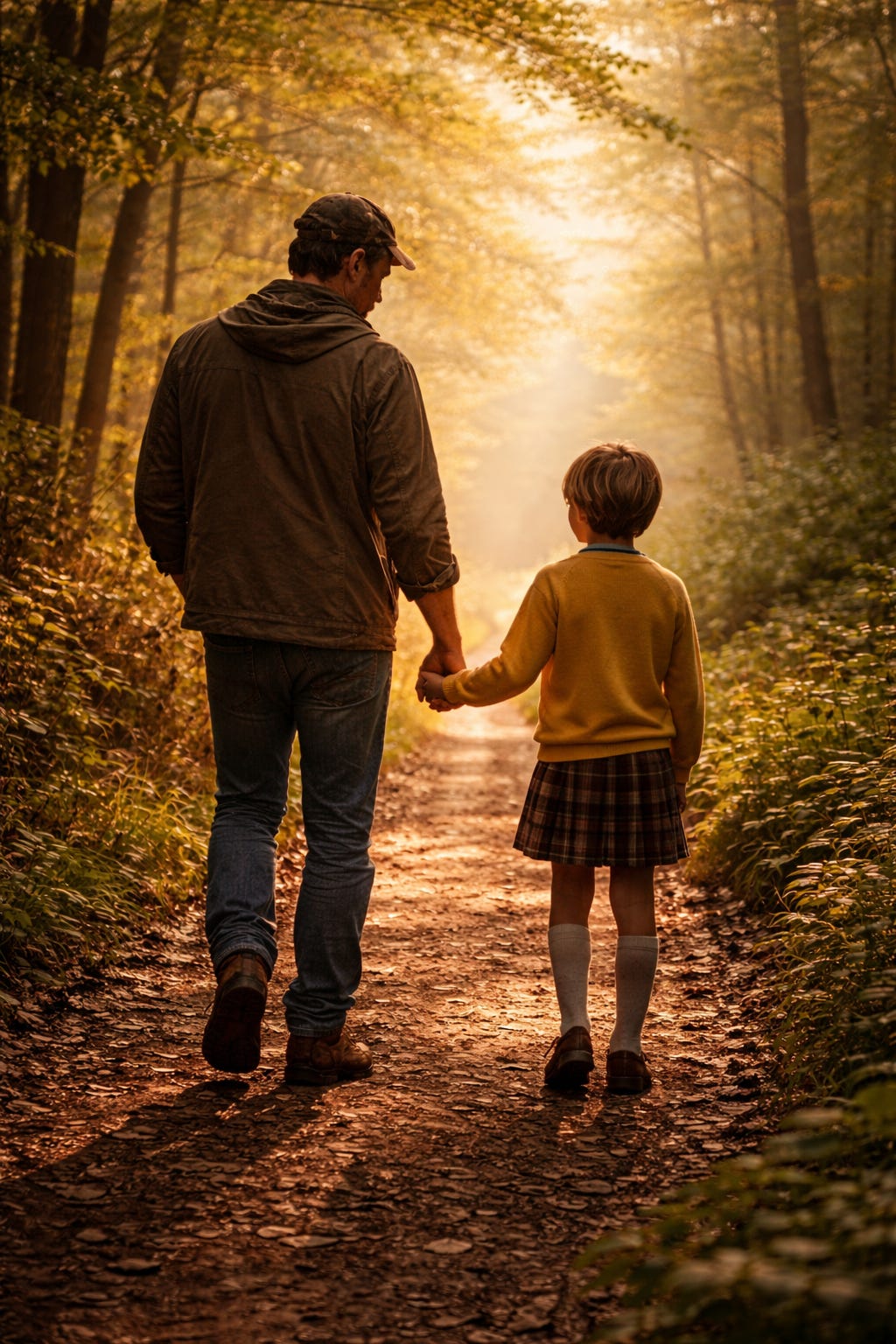
Today I went walking again, holding the child by the hand.
But before I tell you about the walking, I have to tell you about the child. Because if you see it the way I see it, you’ll think I’m carrying him. And if you see it another way, you’ll understand he’s the one carrying me.
I first saw him the day I went into the forest to gather mushrooms.
The forest sits just outside the city. Not close enough to feel like a park, not far enough to feel heroic. You have to walk long enough for the noise inside your head to thin out. I’ve been going there for years. Not because I’m some romantic nature man. Because I’d suffocate otherwise.
I know how to tell the good mushrooms from the poisonous ones. That skill I owe to my ex-mother-in-law.
She used to bring mushrooms to the house, carefully wrapped, smiling gently, saying, “These are the best.” Most of them were not the best. They were wrong. The first time I got sick. The second time too. The third time I woke up sweating, my stomach twisted, and I realized something simple and humiliating: I had trusted without checking. I had eaten what was handed to me because it came with affection.
The fourth time, I did not eat.
I boiled them alone. I waited. I threw most away. I tasted a small piece. I waited again. Then I started reading. Asking. Learning. I learned to examine the stem, the gills, the smell. I learned patience. I learned that not everything offered warmly is safe.
And I learned something worse than mushroom taxonomy. Some poisons do not burn your stomach. They burn the way you see yourself.
That afternoon, years later, I went into the forest to make soup. For myself and my two housemates: an owl and a purple fish.
The owl arrived one night on the roof when everything in my life had collapsed into dust. It sat on the railing and stared at me with those eyes that seem to know what you did when you were thirteen. I fed it. I left the window open. It stayed. Since then, it watches. It never speaks, but it sees.
The fish I bought from a shop that sold “exotics.” It was purple, as if light had made a mistake. I bought it during a week when I stopped believing in normal. The fish eats whatever I give it, but it seems to prefer spaghetti with meat sauce. I don’t question it anymore. Life doesn’t follow rules. It follows impulses.
That day in the forest, the child was sitting on a fallen trunk.
Short hair. Yellow V-neck sweater. Tartan skirt in real cashmere. A giant safety pin fastened across the fabric, as if holding something from tearing. High socks. Mounier loafers pressed into mud. Dressed for somewhere else. Ended up here.
He looked at me with a heavy gaze. I thought he was scared. I was angry.
I had just come through a time when someone made me a promise and did not keep it. Not a small promise. Not “I’ll call you later.” A promise that rearranges you if you believe it.
He said, “I’ll stay.” He said, “You won’t go through this alone.” He said it in my kitchen, hands wrapped around mine, voice low, eyes steady. I believed him. That was my mistake. Not that he left. That I believed him like a drowning man believes a rope.
He disappeared cleanly. One message. “I can’t.” No explanation large enough to hold the damage. No conversation. Just absence.
That absence built a quiet anger in me. Not explosive. Smoldering. A coal I carried inside my ribs.
So when I saw the child sitting on that trunk, I thought, please, I don’t have room for you.
I walked past him. Gathered mushrooms. Went home. Said nothing.
That night I didn’t make soup. We ordered pizza. The owl watched me with open disappointment. The fish spun tight circles in its bowl. I ate two slices and sat on the floor, leaning against the couch, feeling observed from somewhere inside myself.
The next day I returned to the forest.
He was there again.
And the next day.
And the next.
Always sitting. Always watching.
My anger grew. Not because of him, but because I couldn’t erase him. Because I couldn’t manage this presence with logic.
One afternoon it broke.
I stood in front of him.
“What do you want?” I said. “Should I take you somewhere? Should I leave? Just don’t stand there looking at me like that.”
He looked straight at me.
Then he screamed without sound.
The air tightened.
“Don’t you recognize me?” he asked.
My body understood before my mind did.
He was not afraid.
He was furious.
“No one protected me,” he said.
“It wasn’t my fault,” I whispered. The apology slipped out before I knew who I was apologizing to.
“I know,” he replied. Not gently. Precisely.
He stepped closer and studied my hands, as if looking for scars.
“When he left,” he said, “you pretended you weren’t hurt.”
“I didn’t know how to do anything else.”
That was true. I had learned to gather myself. To say “I’m fine.” To avoid making a scene. To never be the one who needs too much.
“You learned to identify poisonous mushrooms,” he said. “Why didn’t you learn to identify poisonous people?”
The question landed in my chest like a stone.
I stayed silent.
“I’m not asking you to save me,” he continued. “I’m asking you not to make me invisible.”
“How?” I asked.
“Stop pushing me back into the woods every time someone hurts you.”
That was when I understood.
The child was not a symbol. He was not a metaphor I could intellectualize.
He was the part of me that felt abandoned long before that kitchen promise.
The part that waited by windows.
The part that learned to be quiet because loud feelings weren’t welcomed.
I reached out my hand.
He hesitated.
Then he took it.
His skin was warm. Solid. Not a ghost. Not an illusion.
Since then, we walk together.
The first walks were not poetic. They were tense. He spoke sharply. I defended myself automatically.
He told me about a room that smelled like cleaning products. About a voice saying, “Don’t make a fuss.” About a hand gripping his wrist too tightly. About the moment he realized that adults do not always protect.
He never gave names. He didn’t need to. I felt them.
I told him about my version of growing up. About learning to be “a man” in a way that calcified me. About laughing when something hurt. About eating alone instead of admitting I was lonely.
I told him about the kitchen. About the promise. About the touch. About the silence afterward.
He listened without sympathy.
“He didn’t just leave,” the boy said. “You left too. You left me. So you wouldn’t feel it.”
That was harder to hear than the abandonment.
There were days he refused to speak. We walked side by side, his hand stiff in mine.
“Will you leave me again?” he asked once.
“No.”
“Like before?”
“No.”
He didn’t believe me.
So I stopped trying to convince him with words. I held his hand and kept walking.
The house shifted too.
The owl began coming inside more often. It perched high and watched us without blinking.
The fish slowed its frantic circling.
One night, the boy sat by the aquarium and dropped a crumb of bread into the water. The fish rose gently and took it. The owl blinked once, slow approval.
Something in the room softened.
In the forest one day he stopped.
“I want to scream,” he said.
“Then scream.”
He opened his mouth. No sound came out.
But something inside my body cracked open. My stomach tightened, then loosened. Air moved through a space that had been locked for years.
That was when I realized my anger had been armor.
Under it was fear.
Under the fear was grief.
Under the grief was that boy.
He did not want to heal me. He wanted to exist.
That night I made mushroom soup. Carefully. With the right ones. The owl ate. The boy ate. The fish made one irritated loop and then took a bite anyway.
We sat there. Not distracted. Not elsewhere.
“I don’t want to be your lesson,” he said quietly.
“You’re not.”
“I don’t want to be your metaphor.”
“You’re not.”
“Then what am I?”
“You’re me,” I said. “And I’m done pretending you’re not here.”
Now we walk.
We talk about those who left. Those who disappointed. Those who smiled while offering something toxic.
We talk about the times I helped abandon myself.
There are moments when he grips my hand tighter, afraid I’ll drift. There are moments when I feel the old impulse to say “It’s fine. Move on.” But I don’t.
No one protected us.
So we will.
Until we don’t need to anymore.
We made an agreement. We will stay together until the wound closes. And when it does, we will let go. Not as separation. As integration.
I don’t know when wounds close. Maybe they don’t close entirely. Maybe they just shrink enough that you can walk without stepping on them.
Today, while we were walking, he turned to me and asked:
“Are we coming back tomorrow?”
“Yes,” I said.
And that “yes” was not obligation.
It was presence.
As we walked back, his yellow sweater glowed against the trees like a small private light. Not a light you show the world. A light that keeps you from losing yourself.
No one protected us.
We will.
Until it’s no longer necessary.
Until holding hands becomes unnecessary.
Until the boy and the man are no longer two.
Just one human being.
Standing.