

The Blue That Stayed
An American longform piece about memory, lost love, and the way time does not always untangle people, but leaves them living inside the ache of who they once were together.

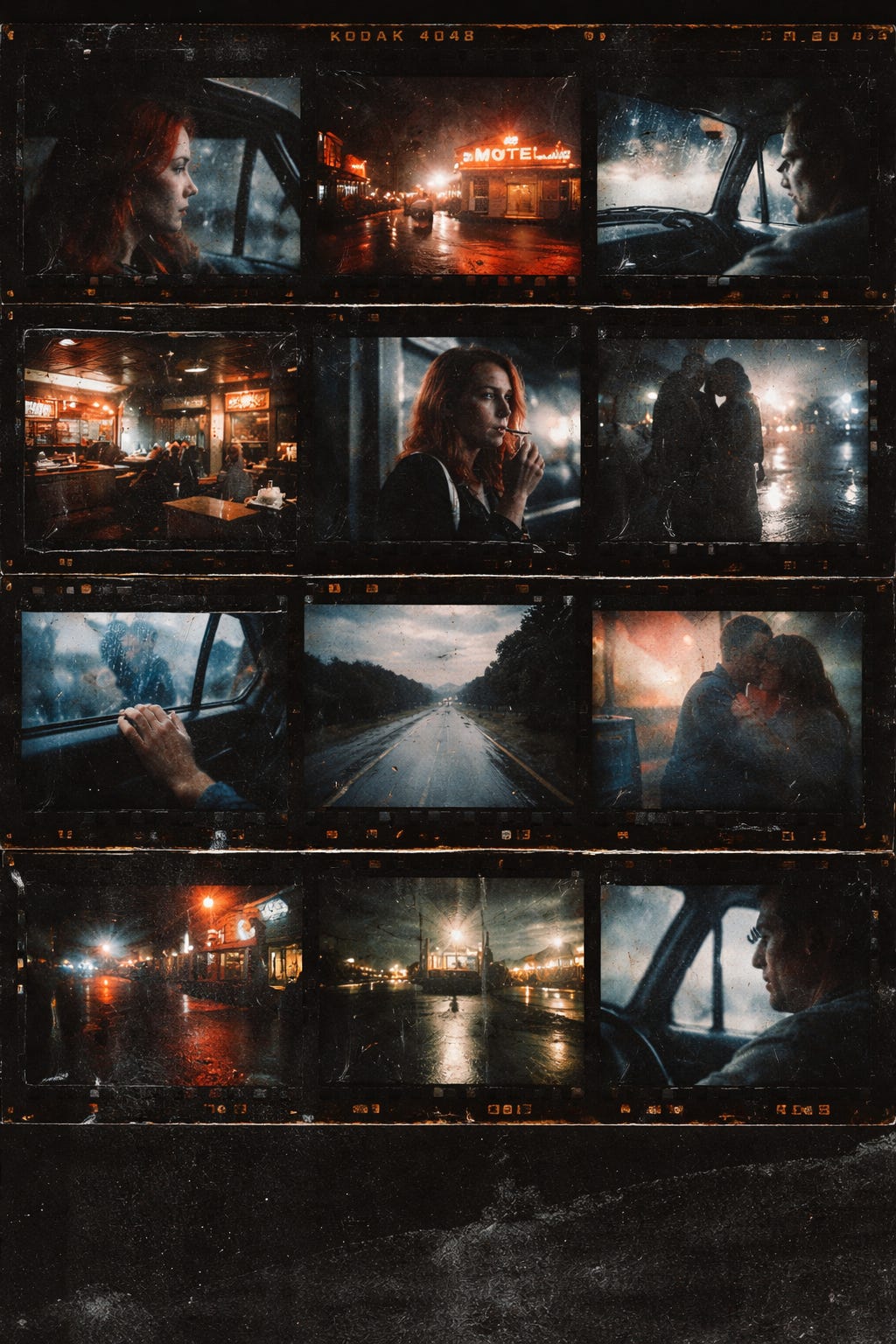
The first thing he remembered about Helen was not her face. It was the color. A deep, strange reddish color in her hair, like rust on old iron after rain. Whenever he thought of her again, even after all those years, it was never her voice that came first, nor her body, nor any particular sentence. It was that color. And then a morning light, a cheap room, the sheet half-pulled aside, and himself lying awake staring at the ceiling, wondering whether she had changed, whether she had put on weight, whether she had grown old, whether she still laughed the way she did then or whether life had gotten into her mouth too and stolen the music from it.
Cole Mercer was fifty-two when that sickness of memory began to seize him again. He worked in a small garage outside Providence, changed oil, changed tires, fixed noises in old engines, and his body had taken on the permanent shape of men who have spent their lives bent over metal. His hands smelled of grease no matter how often he washed them. At night he returned to an apartment with one bed, one table, one coffee pot, and two windows looking out onto a parking lot. He was not pitiable, and he was not exceptional. He was the kind of man people rarely remember correctly. And yet inside him he carried a story large enough to have bent the whole course of his life.
That morning found him awake before the alarm. Outside, it was raining. The rain came down over the cars in the lot with that indifferent rhythm things have when they do not care who they wake. He lay there staring at the ceiling. It was one of those mornings when a man is no longer fully in the present but in a room made of other years. That was where the thought of her found him. Whether she was still red-haired. Whether her hands had lost that nervous grace. Whether she had finally learned to stay anywhere at all or whether, like him, she still carried the sound of the road inside her.
He did not see her. He remembered her. And memory is more violent than image because it never gives you the whole body. It only gives you what it chooses to keep and torment you with.
He had met her when he was twenty-three. Back then he was working in a small gas station outside Gary, Indiana, a place that seemed to exist only so people in a hurry to be somewhere else could pass through it. It was winter turning bad, with roads full of gray snow, salt, and black water. She came into the station just before dark. She was wearing a man’s coat too big for her body, muddy boots, and she had on her face that expression people wear when they pretend to know where they are going even though they have only just left somewhere they could not bear any longer.
She walked up to the counter and said:
“You got coffee, or just that liquid you serve as punishment?”
Cole looked at her.
“If I say it’s good, I’ll be lying. If I say it’s terrible, you’ll want it more.”
She smiled a little.
“Fine. Give me the honest terrible.”
He filled a paper cup for her. She paid in coins. Sat by the window and drank it slowly, looking outside as if waiting for something to appear on the road or afraid something might. After a while a man walked in, wearing a good coat, tired eyes, and the air of someone who believed the world owed him explanation. He looked straight toward the window.
“Helen,” he said.
She did not turn at once.
“You shouldn’t have followed me.”
The man came closer.
“You can’t just leave like this.”
“It already happened.”
“Come home.”
Then she turned and looked at him with a gaze Cole never forgot. Not hatred. Not exactly. It was the look of a person who had once loved and now saw before her not the beloved but the cage itself.
“It isn’t home,” she said.
The man bent slightly toward her.
“Don’t make a scene.”
And then she laughed. A small, dry laugh.
“The scene ended when I stopped being afraid.”
The man grabbed her wrist. Not hard, but enough. Cole came out from behind the counter before he thought about it.
“Let her go.”
The man looked at him as if discovering him for the first time.
“This is none of your business.”
Cole stepped closer.
“The second you put your hands on her in here, it became mine.”
The man shoved him. Cole shoved back harder than necessary. The rack of chips went over. Her coffee spilled. The owner, who had been in the back room, came out cursing. Within a minute the man was gone, threatening lawyers and the kind of order that had already stopped belonging to him.
Helen bent down, picked up her pack of cigarettes from the floor, and said:
“Looks like I got you into trouble.”
Cole shrugged.
“I was already in trouble. Just changed the type.”
She stood there looking at him for a moment. Then she said:
“You got a car?”
“A Ford that lies about being alive.”
“Good. I want to get out before he comes back.”
“Where?”
Helen lifted the empty coffee cup.
“Far enough is a direction for tonight.”
That was how it began. Not with love. With escape. Those things get confused at the start because when two people run in the same direction, the body tells itself maybe this is destiny, when really it is only shared velocity.
They left before dark settled properly. Cole’s Ford coughed, rattled, and smelled of gasoline and old blanket. There was no destination. They took small roads first, then the highway, then small roads again, as if they believed that if they confused geography enough they might also confuse the lives that were following them.
They drove for hours. Helen told him she had been married for two years to a man who had first seemed safe and then simply seemed heavy. That she had started getting smaller inside the marriage without quite noticing. That one morning she saw his hand on the table, ring, veins, nails, and realized she feared it more than she loved him. Cole did not tell her much about himself. He did not yet know how to speak of himself without shame. He told her only that his father had worked in steel, his mother had sewn for rich women who never remembered her right name, and that from the age of eighteen he had taken jobs the way people catch colds, without ever being asked whether they wanted them.
They stayed one night in a motel with a red sign and rough sheets. They did not make love that night. They slept in the same bed, mostly dressed, each on a side, with that strange current between two people who do not yet know each other enough for intimacy but already know each other too much for indifference.
The next morning she found him outside the motel looking at the car.
“Will it make it to California?” she asked.
Cole laughed.
“No.”
“Then let’s drive until it dies.”
That was what they did.
They passed through Nebraska, Wyoming, Nevada, with the weather changing, with the two of them slowly becoming a couple not by decision but by repetition. The first time she held his hand was in a diner outside Salt Lake when a woman at the next table mistook them for husband and wife and told Helen, “You’ve both got beautiful eyes, you’ll make strong kids.” Helen laughed so hard she cried. Then under the table she touched her fingers to his, as if to test whether life can take those mistakes and sometimes make them real for a little while.
They made love for the first time in a room near Reno, with the window half open and neon light cutting the floor into strips. It was awkward, hurried, a little sad, precisely because both of them knew they were not stepping into anything clean. But they stepped in. And sometimes that is enough for a whole life to be built in memory.
In California the car died for real, just outside Monterey. They left it in a field behind a gas station, the way people bury an animal that carried them farther than it should have been able to. That evening they sat on a hill looking at the lights in the distance.
“What if we stopped here?” Cole asked.
Helen did not turn toward him.
“You’re not talking about here. You’re talking about stopping.”
“Maybe.”
“I don’t know how to stop.”
Cole broke a dry branch in two.
“Neither do I. But sooner or later a person ought to learn.”
Helen pulled her knees to her chest.
“You say that like it’s a virtue.”
Cole did not answer. Inside he already knew they were talking about other things. Not a town. Not a job. They were talking about whether two people who had saved themselves for a while inside each other’s wounds could ever build a house, or whether they were doomed to remember only the running.
They separated a few days later. Not shouting. That was almost worse. It happened on a wet road, in a night with no audience, with small bags and tired faces.
“Maybe it’s better this way,” Helen said.
Cole did not know what to do with the word better. Safer, maybe. More correct, maybe. Better, for whom?
“Will I see you again?”
Helen turned then and looked at him the way she had looked at him in the gas station, only now she was not looking past him at a cage. She was looking forward into fog.
“Somewhere,” she said. “Someday. On some road. That’s how these things happen.”
And she left.
Cole stood and watched her until she became shadow.
After that the years passed the way they pass in people who never fully managed to explain what happened to them. Jobs. Cities. Other beds. Other women. A few good nights, more tired ones. At some point Cole ended up in New Orleans, worked in a warehouse, then on small boats, then in a bar carrying crates behind the kitchen. For a while he lived with a woman named Lena, who had a deep voice and hands full of tiny burn marks from pans and grease. He loved her as much as he could then. Not falsely. But there was always inside him some movement that never finished, as if his heart had learned to leave a little space open for what had not closed properly.
Lena said it to him clearly one night.
“You’re here and you’re not. I don’t know how you do that without lying.”
Cole had gone quiet.
“Is there another woman?”
“No.”
“Then what is there?”
He looked at the table. Thought of saying nothing. But he had grown tired of that word.
“There’s an old room that never empties.”
Lena nodded slowly.
“Then I don’t live in it.”
And she was right.
He never saw Helen again. Not truly. At least. He saw her in stations, in bus windows, in women who turned their heads a particular way, in a red reflection in a shop window after rain, in a sentence spoken by somebody else with a mouth that did not belong to her. Memory does not keep the person. It keeps the poison in the correct dose, enough so that you can function and never be rid of it entirely.
Years later he heard by chance, from a man who knew someone who knew someone, that Helen had passed through Boston, worked in a bookshop, then a laundry, then somewhere up north, then married again, then divorced again. Every piece of news came broken and useless, and yet each one was enough to reopen the whole river inside him. He did not want her back exactly. He wanted that tear in time when they had existed together, before life acquired bills, other people, other speech, other tired versions of themselves.
When he was about forty he passed one evening outside a small bar in Albany and heard a woman singing through the door. He went in without thinking. It was not Helen. She did not even much resemble her. And yet there was something in the voice, a way of breaking just before the right note, that pinned him to the floor. He sat at the bar, drank three whiskeys, and barely heard anything but what had woken inside him.
After the set the singer came over to him.
“You okay?” she asked.
Cole smiled tiredly.
“No. But I’m used to it.”
“To which one?”
“To the no.”
She lit a cigarette.
“Then why are you sitting there like a ghost hit you?”
Cole turned the drink in his glass.
“Because one did.”
He said nothing more. He did not need to. Some people understand that when memory enters through the wrong door, you do not throw it out with explanation.
Once, around forty-five, he found himself on the East Coast for work. It was raining, like then, and that alone was enough. He was standing by the side of the road waiting for a tow truck for a customer’s car when he suddenly remembered the first time he had driven away with her. The road wet. His shoes soaked. The feeling that he was paying dues to a life he had never entirely chosen. Then he understood something that frightened him more than nostalgia. It was not only Helen he missed. He missed that version of himself too, the man he had been before learning how permanently something unfinished can remain inside you.
That is perhaps the worst thing about lost love. You do not mourn only the other person. You mourn the version of yourself that existed with them.
At fifty-two, in the apartment facing the parking lot, all of it came back with such force that he thought something literal might crack inside him. He made coffee, smoked by the window, then sat back down on the bed. The rain went on. And for the first time in years he did not try to push memory back. He let it enter. Let it open every door.
He remembered her sleeping in the car seat with her head turned toward the window.
He remembered a diner at the edge of nowhere where she was eating fries and laughing because the coffee was so bad it felt like revenge.
He remembered her wet hair in a motel bathroom, dripping down her back.
He remembered a night outside Reno when she was reading him a passage from a novel she had found in a cheap bookstore and suddenly stopped because she had begun to cry without even knowing why.
He remembered holding her face in both hands and thinking, without saying it, that if the world ended in that moment, he would not mind.
He remembered her look when they split too. Not only sorrow. Something harder. The knowledge that you can love someone and still not be able to stay with them, because love is not enough. You must also be able to survive the way the other person dreams of being saved.
Cole sat for a long time with his elbows on his knees. Outside it had brightened a little. People were going to work. A woman in the parking lot was carrying a child toward daycare. A man was cursing at his van because it wouldn’t start. Life, as always, was continuing without caring what had happened to two people thirty years earlier.
And yet there in that ordinary rainy day, Cole understood the thing that had tied him all those years. It was not that he had lost the great love and never got over it. That was the cheap version. The truth was more awkward. They had been free for a while, as free as two people can be when they have nothing left to defend, and exactly then they had touched something real too. A human being. Each other. And once that happens, freedom stops being light. It gains weight. Because every road afterward carries the thought that you can go anywhere you want, only that other person is no longer there to leave with you.
Freedom without love is air.
Love without the power to stay becomes a ghost.
And the two together, once separated, leave inside a person a strange blue, not exactly depression, not only loss, but a permanent tangled shade, as if all the years had fallen into the same lake and you can no longer tell what is memory, what is sorrow, what is guilt, what is the desire to rewrite the past just enough to bear the present.
That same evening after work, Cole went to an old bar near the tracks. He did not usually drink out much anymore. He sat alone. Ordered whiskey. The bartender set down a napkin and peanuts beside him without speaking. A woman farther down fed songs into the jukebox. One of them was old and sad, one of those songs about roads, rain, and people who meet again only in the heads of those who lost them.
Cole smiled bitterly.
The bartender looked at him.
“Bad song?”
“No,” Cole said. “Bad timing.”
The bartender nodded. He did not ask more. That is the mercy of certain bars. They let you come apart a little without demanding narrative.
When he got home he sat at the table and took out an old notebook where he sometimes wrote bills and customers’ numbers. On the first blank page he wrote: It wasn’t that we lost the road. It was that we walked it from different points and remembered it differently. He stared at the sentence a long time. Then closed the notebook. He did not need to become the author of his own damage. It was enough that he had finally found the right phrase for it.
He never learned whether Helen still thought of him. Maybe yes. Maybe no. Maybe only on certain accidental mornings like that one, when rain enters through old openings and suddenly throws you back onto a road where you once walked with somebody you could not keep. Maybe she had built herself a life so full that he had become only a bright wound, no longer open but impossible to erase. Maybe she had forgotten his face and remembered only his body beside hers while the car ran through the rain. It did not matter anymore.
What mattered was this.
That some people enter your life and do not stay.
But they alter the way you hear every song afterward.
They alter the temperature of memory.
They alter the word freedom and load it with absence.
They alter the word love and strip it of innocence.
And then you go on living. You work. You grow older. You sleep in other beds. Drink other coffees. Meet other people. But somewhere inside you there is still a wet road, a car that will not go far, a woman with rust-red hair, and a hand once held in the rain as if that were enough to defeat time.
It isn’t.
It never is.
But it remains.
And sometimes what remains is stronger than what you actually got to live.
Cole turned the light off slowly that night. Before lying down, he stood a while at the window. The parking lot was wet again. The lamps broke into little lakes on the asphalt. Somewhere far off a train sounded. He thought that if he could, he would trade whole years, clean, safe, quiet years, just for one afternoon back. On some road, in some car, before wear, before the right distance, before the cost. Only to sit beside her once again and need nothing more than the fact that she was there.
That was his truth.
Not that their love had been perfect.
Not that it had been meant to last.
Not that if they had stayed together they would have been saved.
Only that time does not always untangle people.
Sometimes it tangles them more.
And then leaves them to go on living inside that blue, carrying not simply a lost love, but an older version of their own soul that never found its way fully back.
It's love that had the potential but did not go through.
It happens with most of us .
We carry on with life and meet many others , but that one memory remains embedded in our heart.
Something about it is very special..
Therefore we carry it all our lives.
So much ache in this... in the way he was not only missing her, but the version of himself that existed beside her, and that kind of thing ruins me a little...