
Rusty Nail
Three hours at a bar, and then everything else is war.

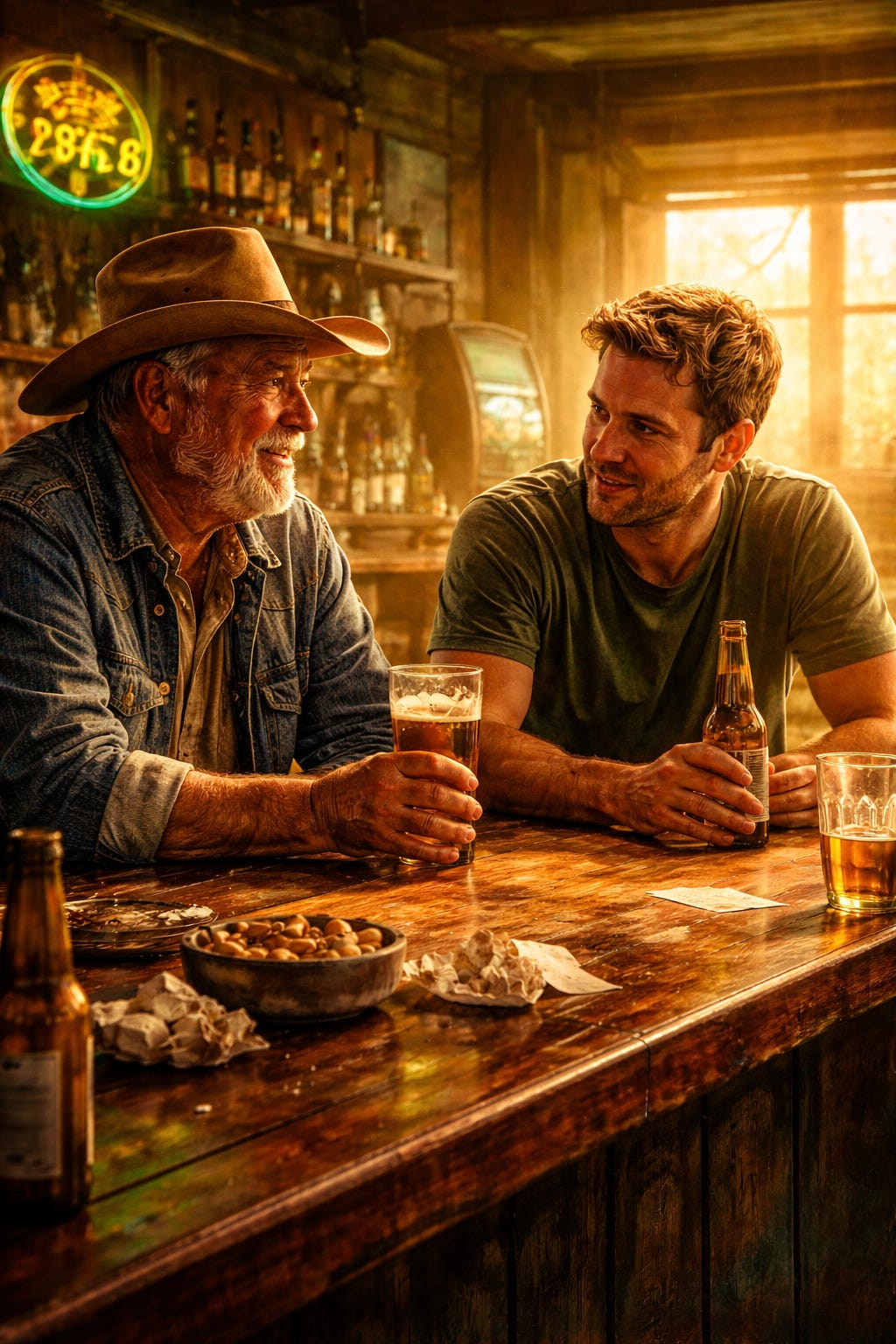
The bar was called Rusty Nail, and it looked like it had not changed since the 1970s. A wooden counter with scratches, faded flags, a TV playing baseball with no sound. It was outside Columbus, on a road that did not lead anywhere important.
That is where I walked in on the night I met Joe Callahan.
I was not looking for anything deep. I worked in a warehouse with car parts, I had just broken up, and that night I only wanted to sit in a corner and drink without anyone asking me “what will you do now”.
I sat at the counter. I ordered a beer.
Next to me was an old man with a cowboy hat and a jacket that had seen better days. He did not look like the kind of guy who drinks to forget. He looked like the kind of guy who drinks to remember.
He looked at me sideways.
“You are not from here.”
“Is it that obvious?”
“Anyone from here does not sit alone at the counter. He goes straight to the table of the lost.”
I smiled.
“Then I guess I am a tourist.”
He raised his glass.
“To the health of the tourists.”
We clinked.
I do not remember who started first, but within ten minutes we were talking as if we had known each other for years. About politics. About women. About the war.
“I served in Vietnam,” he said calmly.
“And I have not served anywhere,” I answered.
He laughed.
“Lucky.”
He did not have the look of a man who wants pity. He had the look of a man who has seen enough and does not need to advertise it.
We ordered a second round.
“Is there a God?” I asked him at some point, without knowing why.
He shrugged.
“If there is not, better that we do not find out. If there is, I hope he has a sense of humor.”
“And life?”
“Life is beer. If you leave it, it gets warm. If you rush it, it turns bitter.”
I laughed. He was simple. But not stupid.
He told me he had been married twice. That he had two kids who “talk to him when they need something”. That he had worked in construction, in fields, in factories.
“And now?”
“Now I live.”
“On what?”
He looked at me. That look that measures you.
“On enough.”
I did not ask more.
The conversation went elsewhere. He told me about a woman he met in Saigon. About a friend who never came back. About the night he thought he would die.
“Were you scared?”
“No. I got angry.”
“At whom?”
“At myself for being scared.”
He lit a cigarette.
“These will kill me,” he said.
“Then why do you smoke?”
“To remember that I can still choose something that harms me.”
I did not know if he was joking.
Two hours passed. Maybe three. We talked about girls we hurt. About mistakes that cannot be fixed. About how people get stranger as they grow older.
At some point, “last call” sounded.
I stood up.
“Nice meeting you.”
“Me too, son.”
I was not his son. But that is how he said it.
“What is your name?” I asked.
“Joe.”
“I am Dave.”
He shook my hand.
His hand was steady. Not old. Steady.
“God is great,” he said softly. “Beer is good. And people...”
“Are crazy?”
He smiled.
“Exactly.”
I stepped out into the cold. I did not turn to look back.
I never saw him again.
Two months later, I was drinking coffee in my apartment when I saw the name in a local newspaper.
Joseph Callahan, 78, Veteran, Business Owner, Philanthropist
I stopped.
I did not know any of that.
I read.
Owner of a logistics company. Investments in real estate. Charities. Estimated fortune: over ten million.
I leaned back.
“Business owner?” I whispered.
The guy who talked about beer and women had a company?
The article mentioned a funeral. I do not know why, but I went.
The church was full. Men in suits. Women in sunglasses. Kids who looked angry.
I stood in the back.
I heard a man in front of me say:
“He left us trouble again.”
A woman answered:
“I hope at least he distributed it right.”
I did not understand what she meant.
The service was short. No one talked about the bar. No one talked about beer.
After the burial, a man in a suit approached a group of relatives.
“You will be informed soon about the will.”
The woman’s face hardened.
“I hope he did not do something crazy.”
I left before it ended.
The next week, my phone rang.
“Mr. David Matthews?”
“Yes.”
“My name is Richard Lewis. I represent the office that manages Joseph Callahan’s will.”
I froze.
“Excuse me?”
“Mr. Callahan mentions you by name.”
I went silent.
“You need to come by our office.”
“Some mistake must have happened.”
“I do not think so.”
I hung up and stared at the wall.
I had talked to him once. Three hours.
What could he have written?
The office was cold. A wooden table. Folders.
Inside were two men and a woman. His children.
They looked at me like I was a stain.
The lawyer cleared his throat.
“Mr. Callahan’s will provides the following...”
I was hearing numbers without understanding them.
A house. Stocks. Accounts.
And then:
“All of his liquid assets and 60 percent of his investments are transferred to Mr. David Matthews.”
The woman jumped up.
“WHO?”
The lawyer looked at me.
“You.”
The blood left my face.
“I... this cannot be. I only knew him...”
The man across from me hit the table.
“What did you do to him?”
“Nothing!”
“Did you manipulate him?”
“I met him in a bar!”
The woman laughed hysterically.
“Of course. Dad and his bar friends.”
The lawyer raised his hand.
“The will is clear. There is also a note.”
He handed me an envelope.
I opened it.
The handwriting was clumsy, but steady.
“To my children I left what they needed. To Dave I leave what listened to me.”
My eyes blurred.
The man across from me leaned in.
“What did you tell him that night?”
I had no answer.
Because the truth was simple.
Nothing.
I listened to him.
And maybe that was something.... The lawyer was talking, Joe’s kids were shouting, and I held the note as if it was hot.
The woman, his daughter, leaned toward me.
“So you want to tell us that a stranger walks into a bar, makes two jokes, buys a beer, and walks out with half?”
“I did not even buy one,” I said.
“Even worse,” her brother snapped. “Then what did you sell him?”
The lawyer cleared his throat.
“Gentlemen, ma’am, there is a procedure. If you believe that...”
“He exploited him,” the son said, without looking at me. He said it like a diagnosis. “Our father was not well. He was alone. He was weak.”
I looked at their faces. Well fed. Well dressed. Angry like someone took something that was already in their hand.
“Did you see him?” I asked, without meaning to.
The daughter laughed.
“See him? Did he ever call us? Did he ever talk to us normally? His whole life was a power game. He played the tough guy. He played the smart one. And in the end... this.”
The son hit the table again.
“In the end he gave it to you.”
The lawyer leaned forward.
“I am obliged to inform you that any threat or harassment toward Mr. Matthews...”
“Do not protect him,” the son said. “You are paid.”
I turned to the lawyer.
“I do not want the money,” I said, and my voice came out sharper than I expected. “I did not ask for it. I did not want it.”
The daughter looked at me with that sly look.
“Ah, okay. You will play the good guy. You will give it back. Great.”
I understood the trick immediately. To corner me in a moral theater. To leave clean. To load the weight onto me.
“I did not say that,” I answered.
The son leaned.
“Then what did you say?”
I took a breath. I felt that every word would be wrong.
“I did not know him. Not like you knew him. I met him in a bar. He was a man who talked. I listened. That was it.”
The daughter spat the word.
“That was enough for him to give you ten million?”
The lawyer made a small motion, almost apologetic.
“Mr. Callahan had also left instructions for a fund. An amount... for veterans and for a local hospital.”
The son laughed bitterly.
“Charity. So he looks good. And he left us... what? A lesson?”
I stood up. My heart felt like a hammer.
“I will leave.”
“Of course you will leave,” the daughter said. “With our money.”
Then something happened that I did not expect. The lawyer, a guy cold until that moment, leaned toward her.
“Ms. Callahan, if you allow me. Your father had the right to dispose of his property as he wanted. And from what I understand... he wanted to make one last choice. Maybe also one last insult. This is not Mr. Matthews’ issue. This is your father’s issue.”
The daughter looked at him as if he stole her air.
“So he hated us?”
The lawyer did not answer.
I left the office like I was being chased. In the parking lot I stood next to my car and did what I never do. I put my head in my hands.
I had taken something I had not asked for. And I had become the target of people who looked ready to break me to get back an idea, not only money.
That same night, the phone rang again. Unknown number.
“Dave?”
The son’s voice. Hoarse, lower now.
“What do you want?”
Silence.
“Where did you meet him?” he asked.
“Rusty Nail.”
“What did he tell you?”
“A lot. Nothing. I do not know.”
“Lies.”
“It is not lies. He was... an old man who wanted to talk.”
A dry laugh on the other end.
“An old man who wanted to punish his children.”
“Maybe. Maybe he just... wanted to see if there is a person who does not look at him like an ATM.”
His voice hardened.
“You see us as monsters.”
“You see me as a thief. And you do not even know me.”
Silence again. Then something like a breath.
“Do you know what he did?” he said finally. “He always told us that love is an act. Not words. And when we asked for something, he gave it... always with terms. Always with control. We never knew if he was helping us or keeping us tied.”
“And now?”
“Now he tied us to you.”
I had no answer.
“Will you let it be like this?” he asked, and it was the first time I heard something human in him. Not a threat. Awkwardness.
“I do not know,” I said. “I swear I do not know.”
He hung up without saying goodbye.
The next day I went to Rusty Nail.
Same wood. Same smell. Same baseball with no sound.
The bartender recognized me.
“You were with Joe that night.”
“Yes.”
“You heard it?”
I nodded.
The bartender leaned over the counter.
“He did not choose you by accident.”
“Did you know him?”
“I knew him as much as you can know a man who does not let anyone know him.”
“Was he... like that?”
The bartender laughed.
“What does like that mean?”
“Alone.”
The bartender wiped a glass, slowly.
“He came every year on the same day. Every year. He drank two beers. He talked a little. Then silence. Then he left. And he always left a tip that did not match the drink.”
“Why?”
The bartender looked at me like I asked something obvious.
“Because he could.”
I stayed there, in the same spot where we sat then. I ordered a beer. I drank half and left it to get warm. I stared at the counter, the scratches, the marks from coins, the dried fingerprints of a life that passes through here and disappears.
“Did he have kids?” I asked.
The bartender shook his head.
“His kids were always angry with him. Or with the world. Or with themselves. I do not know. When they came, the place turned cold.”
“And Joe?”
“Joe drank. And he looked at them as if he had already lost them.”
I felt a sting behind my eyes. Their hatred did not start with me. I was the last nail.
I went outside. The air was cold. The sky was clear. As if nothing had happened.
Days passed. Then weeks. I received papers, notices, bills. Numbers that made me nauseous. I felt like I was carrying something dirty, even if I had never touched it before.
The lawyer told me to think. To protect myself. Not to make quick moves.
“It is not only money,” he said. “It is war now. They will try to break you.”
“I do not want to fight,” I answered.
“Then you will lose.”
And maybe, inside me, one part said: let me lose.
But one night, I saw Joe again in my sleep. Not like a ghost. Like that night. His hat. His cigarette. His phrase, simple and dirty.
And when I woke up, I knew what I had to do, not to look good. So it would not eat me.
I went to the cemetery.
It was a sunny day that felt almost insulting. Birds were singing. The world was doing its work.
I found his grave. A simple plaque.
Joseph Callahan
Veteran
Nothing about millions. Nothing about companies. No “beloved father”.
I took a six pack out of the bag. I left it next to the plaque.
“I do not know what the hell you did,” I said out loud, and I heard it vanish in the air. “I do not know why. And I do not know if it was fair.”
I sat on the grass. I did not want to look grateful. I did not feel grateful. I felt trapped.
“Your kids hate me,” I continued. “And maybe they have a reason. Maybe you have a reason too. But you cannot make me your last joke. You cannot leave them like this. Or me.”
I looked at the plaque.
“If you wanted me to keep you company, ok. I kept you company. Three hours. Done. If you wanted to punish, find another way. I am not your tool.”
I stood up, brushed off the grass.
And then, before I left, I did something that scared me.
I told the truth.
“I listened to you that night because I was alone too. Not because I am good. Because I needed a person to talk to without being asked what I will do now.”
I took a breath.
“And now you left me a life I did not ask for. That is crazy. That is people.”
I turned to leave.
In the parking lot, I saw a car stopped. His son. He sat inside. He was watching me. He did not move.
I walked closer slowly. I did not know if I should.
He rolled down the window.
“Did you come to insult me?” I asked.
He shook his head.
“I came to see if you would come.”
“Why?”
He gripped the steering wheel.
“Because...” he said and got stuck. “Because none of us came. Not to the funeral after the formal part. Not after. We could not handle it.”
“And now?”
He looked at me, and for the first time I did not see only anger. I saw shame.
“I saw the will as an attack. Like he spit on us. And maybe he did. But...” he stopped. “Maybe he wanted to tell us something. And we are not hearing it. Like always.”
I did not speak.
“Will you keep them?” he asked.
That was the dilemma. The real one. Not the legal one. The human one.
“I do not know,” I said.
He lifted his gaze toward the grave.
“If you keep them, I will hate you. If you give them back, I will hate you because it will look like charity. There is no right move.”
“I know.”
He clenched his teeth.
“You listened to him,” he said finally. “I... I never listened to him. I only fought him. And he fought back. To the end.”
His voice cracked, very slightly, like a split.
“What did he say about us?” he asked.
I shook my head.
“Nothing bad. Nothing good. He spoke like a man who has already given up on explaining.”
The son looked ahead. He stayed like that.
“Do you know what is the worst?” he said. “That now that he is dead, his only voice... is the money. Again.”
I had no answer.
He started the engine.
“If you decide something...” he said and stopped.
“Yes?”
“Do not do it to be good. Do it so it ends. Because otherwise it will eat you too.”
He drove off.
I was left alone, my hand smelling like beer from the six pack.
I went back home. I opened the envelope with the note one more time.
To Dave I leave what listened to me.
It was not thank you. It was an accusation. It was a nail for everyone else, and I was the wall that held it.
That same night I called the lawyer.
“I want to build something,” I told him.
“What thing?”
“A fund. Not charity so I look like a saint. Something that cuts the circle. Veterans. Hospital. And... something for people who work and still cannot make it.”
“They will say you are laundering.”
“Let them.”
Silence on the other end.
“And the kids?” he asked.
I stared at the void.
“I will leave them a piece. Not to win them. So this does not become war forever. But not all. Not the way he set it up.”
“They will challenge it.”
“Let them challenge it. At least it will be something of mine. Not his.”
I hung up and I felt, for the first time, not relief. Something else. A weight that was changing position.
The next day I went back to Rusty Nail. I sat at the counter. I ordered one beer.
The bartender looked at me.
“Back again?”
“Yes.”
“Why?”
I looked at the scratches in the wood.
“Because people are crazy,” I said.
The bartender smiled without cheer.
“And God?”
I raised my glass.
“If he exists, I hope he has a sense of humor.”
I drank.
And there, in the noise of the bar, I understood something I did not like.
Joe did not give me money because I was special.
He gave it to me because I was available.
And that is the darkest part. The most human.
That a life can change, not by love, not by virtue, not by greatness.
By one chair next to another chair.
By three hours.
By an “I hear you”.
And then, everything else is war.
What strikes me most is how the story avoids the obvious moves. The inheritance-from-a-stranger setup could so easily become a fairy tale or a moral fable with a clean lesson at the end, but it refuses to do that. Dave doesn't suddenly feel grateful and enlightened. He feels trapped. That's honest. That's rare.
The voice is doing interesting work too — stripped down, almost clipped, like someone narrating something they're still trying to figure out while they're talking. The short sentences aren't a stylistic tic, they're load-bearing. They carry the numbness of a guy who's been hit by something he didn't see coming and is still processing it on his feet.
Very well written.
I knew someone who was very wealthy and lonely.
I would meet him occasionally and he would talk about his times , career and other things.
His wife died early.
They did not have children.
He loved to talk and lived in a country house.
He was diabetic and depended heavily on his daily insulin injections.
A charity worker met him in a club by chance .
They became close friends and the charity worker helped him fight his loneliness.
When my relative died , he left more than half of his wealth to this charity worker.
I can relate to this story.