

Night Route
Sometimes kids do not need a lecture. They need a little more road.

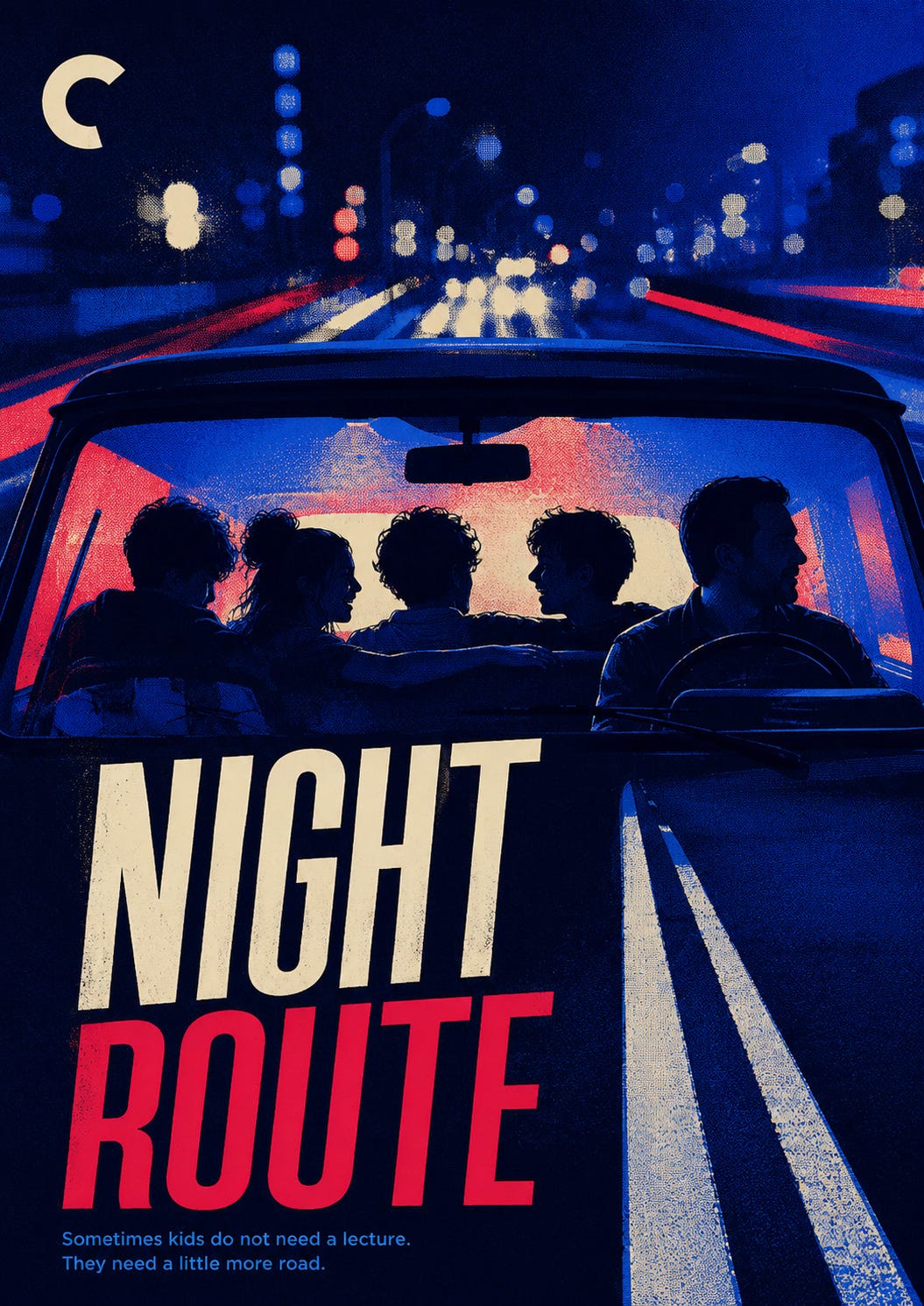
Some parents have a family car. I apparently operate a small unofficial night shuttle for teenagers.
Some parents have a family car. I apparently operate a small unofficial night shuttle for teenagers, with an unstable schedule, suspiciously flexible routes, and a payment system that has not yet been approved by any tax authority.
Whenever my daughter asks if I can also drive her friends home after a night out, I always give her the same answer.
“Sure. Are they paying cash or card?”
It is one of those father jokes that dies, gets resurrected, dies again with slightly more embarrassment, and eventually becomes family tradition because nobody had the energy to stop it in time.
Sometimes I say it to the kids too. They look at me with that very specific teenage expression, a mixture of pity, patience, and “fine, at least he is driving us home.”
The useful thing is that I have a van. Not exactly a van, but close enough. Big enough to carry kids, bags, jackets, half-finished drinks, secrets, glances, elbows accidentally touching other elbows, and that strange electric atmosphere of adolescence that does not really fit anywhere, so it squeezes itself into any available space.
This happened a few weeks ago. Saturday night. The agreement was simple. I would pick them up after their night out and take everyone home around midnight. Honest business. Driver, father, part-time taxi service, part-time security escort, part-time invisible witness to an age that thinks you are not watching, while in fact you see much more than you can comfortably admit.
We dropped off some of the kids first. They said goodbye loudly, laughed, threw half-sentences at each other that I did not always catch, and disappeared into the entrances of their homes with that strange teenage speed, as if reality were chasing them.
By the end, there were four of them left in the car: my daughter, her best friend, and two boys I already knew. Good kids. The kind who have not yet decided what role they will play in the world, but are trying very hard to look as if they have it all arranged.
And I could feel that something was happening.
Not something huge. Not drama. Not anything that required alarms, parental committees, or a PowerPoint presentation titled “The Dangers of Adolescence.” Something small. Something in the air. A laugh slightly louder than necessary. A silence that landed suddenly and then broke too quickly. A way of speaking without saying what was really being said.
My daughter had put on their music. Trap, loud, full of lyrics that, if printed on paper, might make you want to form a cultural emergency council. But inside that car, on that specific night, it was simply the soundtrack of their age. Swearing, boasting, exaggeration, fake toughness, and underneath all of it, the very real need to exist loudly. To not disappear. To not feel small.
I had closed the windows so we would not disturb the neighborhood. They were singing every word. Every single word. Incredible, really. They can forget where they left their jacket, their homework, the time, the charger, the entire concept of responsibility, but they can remember one hundred and twenty consecutive curse words with perfect breathing and timing.
Teenage memory is an illegal archive. It keeps only what burns.
The music was hitting the windows. The kids were singing as if the night belonged to them. I was driving through this small moving room where nobody wanted to be exactly where they were, but everybody wanted it to last a little longer.
We were getting close to the boys’ house. That was supposed to be the end of the route. They would get out, say goodnight, the two girls would stay in the car, we would go home, and the night would close properly and responsibly.
But adolescence rarely asks for much.
Most of the time, it asks for just a little more time.
Five extra minutes that feel like inheritance. One more turn. One small delay. One tiny rebellion against the sentence, “It is time to go home.”
So I asked, almost casually, as if I understood nothing.
“Do you want to take a drive and I’ll drop you off a bit later?”
From the back came a “YES!” so immediate, so unified, so perfectly coordinated, that for a moment I realized teenagers are fully capable of organizing themselves when the subject is not school.
And just like that, the van took off.
We did not go anywhere important. That is the beautiful part. Some of the most important drives of your life have no destination. You circle streets you already know. You pass lights, corners, closed shops, houses with curtains drawn, and inside the car something happens that cannot be written on any map.
In the back, the music got even louder. They sang, laughed, said their things. There may have been some squeezing together. A hand finding an excuse. A shoulder staying a little longer next to another shoulder. Those small, ridiculous, enormous things that at fifteen can build or ruin an entire week.
And then I remembered myself.
Not with clean nostalgia. Nostalgia is a liar. It softens the edges, adds warm lighting, edits out the awkwardness. I remembered it more plainly. I remembered a girl I really liked then. Really liked. One of those teenage “reallys” that has no proper measurement because you have not yet learned how to protect yourself from your own feelings.
I remembered the moment when everything was about to become a little more beautiful, a little more real, and suddenly she had to leave. She had to go home. The night had to end because some adult, somewhere, had drawn a line.
I never saw her again.
The funny thing is, I do not even remember all the details anymore. But I remember the feeling. That silent “a little longer” that never got said. The absurd weight a fifteen-year-old can feel because life did not give him one more turn.
Maybe that is why I did not lecture anyone that night. Maybe that is why I did not lower the music. Maybe that is why I did not ask too many questions.
Sometimes the adult does not need to understand everything.
Sometimes he only needs to remember enough.
I checked with the boys’ parents first. We were not exactly outlaws of the avenue. We simply extended the permission to stay inside a small democracy of seats. Then we kept driving. I was in front, apparently the driver. They were in the back, apparently the children. In reality, we were all carrying something else. They carried their now. I carried an old now of mine that had never properly closed.
When we finally dropped the boys off, a little before one, they got out as if they had returned from a secret trip they would never be able to explain without making it smaller. They were thrilled. The girls too. From the back came laughter, whispers, and that particular teenage speed with which an ordinary night becomes material for future mythology.
“THANK YOU!” the kids shouted.
And they meant it.
Not the way people say thank you out of politeness. They said it the way people say it when you have given them something small that was not small to them at all.
On the way home, the two girls in the back were practically flying. They were talking, replaying scenes that had happened five minutes earlier, laughing at details I had missed and probably should have missed. That is also one of the quiet arts of parenting: knowing when not to hear too clearly.
We got home. The night gathered its things. The lights went low. The music stopped. The van turned back into a car.
Before going to bed, my daughter said:
“Thank you, Dad.”
And that was it.
No grand scene. No speech. No conclusion tied with a ribbon. Just one sentence left at the edge of the night, the kind that sounds small when it is spoken and then grows inside you later.
I slept better that night than I had in a long time. I must have been smiling in my sleep. Not because I had done something great. Quite the opposite. Because I had done something simple and had not ruined it by trying to make it important.
Sometimes that is what our children ask from us. Not to understand them completely. That is probably impossible, and maybe it should be. Not to approve every song, every word, every look, every awkward silence. But to stand close enough for them to be safe, and far enough for them to feel free.
To keep our hands on the wheel without taking over the scene.
To close the windows so we do not disturb the neighborhood, but not close the moment.
In the end, they paid me properly.
Not in cash.
Not by card.
With a “thank you, Dad” that is still driving around inside me.
How you turn a phrase. This is the best writing I've seen here in weeks, and your scene had this old man misting up. You don't need to know why. Thanks from me too, that was quite the ride.