
Don’t Come Back
A story about young love, violence, shame, and the guilt of surviving after someone else steps in front of the bullet

Part One
Samuel Kane always woke before the gunshot.
That was the worst part.
The dream reached the same point every night, the same darkness, the same yard, the same yellow light above the porch, the same voice breaking through the telephone.
Then it stopped.
It never let him see the ending again.
Only remember it.
He would jolt awake sweating, the sheets wrapped around his legs as if they were trying to hold him down. He would lie still in the dark and listen to his heart beating. The apartment room was small. One bed, one chair, one table marked by old glasses, one lamp with a torn shade. Outside, the city continued. Trucks, distant sirens, people coming home from shifts, people going to other shifts. The world had the nerve to go on.
Sam was twenty two now.
She was nineteen forever.
In court, when they asked him when he had last seen her alive, he gave the time. He gave the place. He said it had been raining a little, not properly, just a drizzle that made the lights look blurred. He said she ran toward him. He said she shouted. He said her father was holding a gun.
He did not say that for one second, the stupidest second of his life, he felt relief when he saw her come out of the house.
Alive.
Standing.
With her hair stuck to her face and blood at the corner of her mouth, but alive.
Lila Brooks lived in a white house outside Milford Run, behind her father’s garage. The house was not poor. That was what people said, as if a proper roof and clean curtains meant safety. They had a lawn, a swing in the yard, a doorbell, a kitchen with blue tiles. Her father, Harlan Brooks, had two trucks, customers, a permanent seat in church, and a voice that made men go quiet when he entered a bar.
He was one of those men who said “my daughter” the way others say “my house,” “my field,” “my gun.”
Lila laughed at that in the beginning.
“Don’t take him seriously,” she told Sam. “He doesn’t know how to love without putting a lock on it.”
Sam was the son of a truck driver and a woman who cleaned rooms at the motel near the highway exit. He worked at Roland’s gas station, changed oil, cleaned windows, filled tanks, and dreamed of leaving with enough money for escape not to look like childish stubbornness.
Lila worked afternoons at Mrs. Davis’s small pharmacy, made ribbons for her hair when she was bored, read travel magazines, and had a habit of turning the pages carefully, as if she did not want to hurt the photographs.
They met at the drive in movie theater.
He was selling soft drinks. She came to buy popcorn, but had forgotten her money in the car. Sam gave it to her without waiting.
“I’ll owe you,” she said.
“Two dollars and fifteen cents,” he said.
“Hard man.”
“Business mind.”
The next week she brought him the money in an envelope, with a small note inside that read:
Don’t spend it all on bad decisions.
He kept the note longer than he kept the money.
It was not a great love at first. It was small things. Drives in his old car, music low because the radio crackled, fries from the drive in, kisses behind the closed basketball court, plans they said without fully believing them.
“We’ll leave,” Lila said.
“Where?”
“Somewhere people don’t know my father’s name before mine.”
“Big country.”
“Then we have no excuse.”
Sam loved her in the clumsy way someone loves when no one has taught him how to hold something without squeezing it until it breaks. He loved her and he was afraid. Not of her. Of the possibility of giving her a life smaller than her dreams.
Harlan understood it early.
At first he underestimated him. He called him “kid” and “son” in a way that had nothing fatherly in it. When Sam came to pick Lila up, Harlan stood on the porch with a glass in his hand and looked at the tires of Sam’s car, his shoes, his shirt, everything except his eyes.
“What time will she be back?”
“Eleven, Mr. Brooks.”
“Ten thirty.”
Lila would come out from inside and call:
“Dad.”
He would not answer.
He would just drink.
Lila’s mother, June, was a woman who had learned to walk inside the house without making a sound. Her face had once been beautiful, but now it looked as if she had apologized so many times that the skin itself had grown tired. She spoke little. When Harlan shouted, she wiped the counter, straightened towels, did something with her hands so it would not show that they were trembling.
Once, Lila told Sam:
“Mom believes that if you don’t look at the storm, it will pass over you.”
“And does it?”
“No. It just teaches you to live wet.”
In the fall, Lila began to grow quieter.
It was not exactly sadness. It was as if she were listening to something inside herself and waiting to understand whether it was threat or calling. Sam asked her what was wrong. She said nothing. Then she kissed him quickly, as if she wanted to close the question with her mouth.
One night, in early November, she called him at the gas station. Her voice was low.
“Can you come after your shift?”
“Did something happen?”
“No. Yes. I don’t know. Come.”
He found her behind the closed school, wearing a coat and keeping her hands in her pockets. It was cold. The court was empty. From the nearby gym, the sound of a basketball practice echoed from the floor.
Lila told him without introduction.
“I’m pregnant.”
Sam stood looking at her.
Not because he did not understand.
Because he understood everything at once and none of it fit on his face.
Lila lowered her eyes.
“Say something.”
He opened his mouth.
Closed it.
Then said the most useless thing he could have said.
“Are you sure?”
Lila laughed once, small and ugly.
“How much I wish we hadn’t started with that.”
Sam moved closer.
“I’m sorry. I didn’t mean...”
“I know what you meant.”
“I got scared.”
“So did I.”
They sat on the cold concrete, side by side.
For a long time they did not speak.
Then Sam said:
“We’ll get married.”
Lila turned toward him.
“Don’t say it like you’re putting a bandage on a cut off hand.”
“I mean it.”
“I know. That scares me more.”
He took her hand.
“I’ll get a second job. I’ll talk to Roland. Maybe he has a room above the garage. Or we’ll go to the city. I don’t know. But we’ll do it together.”
Lila looked at him then. Not as if she believed him. As if she wanted so badly to believe him that the wanting itself hurt her.
“My father will kill you.”
Sam tried to smile.
“He can’t kill everyone he doesn’t like.”
Lila did not smile.
“You don’t know him when he’s ashamed.”
Harlan’s shame came before he learned anything.
It was as if he smelled it in the house. He began asking where she was going, why she was not eating, why she slept so much, why she wore loose shirts. June looked at her with eyes that pleaded and accused at the same time. Lila tried to hold herself together. To find a day. To find an hour. To tell the truth as a person, not as the accused.
She did not make it in time.
One afternoon, Mrs. Davis asked her at the pharmacy if she wanted to sit down because she looked white as paper. Mrs. Howell was there, buying vitamins, and leaned in to listen. By evening, Milford Run had begun to chew.
The next day, Harlan came home early.
Lila knew it from the sound of the door.
He did not close it.
He slammed it.
Part Two
The phone call came at eleven seventeen.
Sam remembered the time because he was looking at the clock above the gas station counter when it rang. The night was freezing and empty. Roland had gone home. The road in front of the pumps shone with drizzle. Something was playing low on the radio, but Sam was not listening. He was writing numbers on a piece of paper. What he had in the bank. What he owed. How much a marriage license cost. How much rent Mrs. Pelham wanted for the room above the laundromat.
He picked up the receiver.
“Roland’s Gas.”
Breathing on the other end.
Then her voice.
“Sam.”
He stood immediately.
“Lila?”
“Don’t come here.”
Her voice was cut, but she was trying to keep it clear.
“What happened?”
“Don’t come. Please. Listen to me this time.”
“Are you okay?”
Silence.
And inside the silence, something distant. A man shouting. A door. Maybe June, saying “Harlan, no.”
Sam felt his stomach drop.
“What did he do to you?”
“It doesn’t matter.”
“It does.”
“Sam, listen. He went outside. He took the gun from the cabinet. He said he was going to find you.”
Sam went still.
“Where is he now?”
“I don’t know. He left in the truck. Then came back. Then left again. He isn’t thinking right. He’s drinking. He says you ruined his house.”
“Where are you?”
“In my room.”
Her voice broke for the first time.
“I locked the door, but the lock doesn’t hold well.”
Sam had already taken his keys.
“I’m coming.”
“No.”
“Lila.”
“No!”
Her scream froze him.
Then she whispered:
“If you come, it will become what he wants. He’ll find you in front of him. He’ll have a reason. He’ll say you came into his house. He’ll say you threatened him. He’ll say whatever he needs. Please, go. Go to the sheriff. Go anywhere. Don’t come here.”
“I’ll call the sheriff and then I’m coming.”
“Sam, I’m pregnant.”
She said it as if hearing it for the first time.
“I know.”
“No. Hear it. I’m pregnant. It isn’t just us and our stupid promises anymore. If you come trying to be brave, you may kill all of us.”
The receiver creaked in his hand.
“I can’t leave you there.”
“You can. You have to. I’ll...”
A loud crash on the other end.
Lila made a sound.
Not a word.
Terror.
Sam shouted her name.
“Lila!”
Her voice returned, farther away now.
“Daddy, please...”
Sam did not hear the rest clearly. Only noise. Wood. Footsteps. Harlan’s voice, hoarse, broken by drink and anger.
“Where is he? Did you call him?”
Then Lila at the receiver, panting.
“Run, Sam.”
“No.”
“Run.”
The line went dead.
Sam called the sheriff’s office. It rang. Rang. Rang. No one. He called the deputy’s house. His wife answered and said Ray was at a crash out on Brighton Road. He called the Brooks house. Busy. Or dead. He did not know.
Then he did what Lila had asked him not to do.
He got into the car.
He drove as if speed could repair life. The headlights cut the road. The tires slipped on the turns. He passed houses with closed windows, fields, fences, dark barns. His mind said stupid things.
I’ll make it.
I’ll get her.
We’ll leave.
We’ll go to the city.
We’ll laugh about this someday.
He did not believe it.
But the mind, when it is afraid, builds false bridges over cliffs.
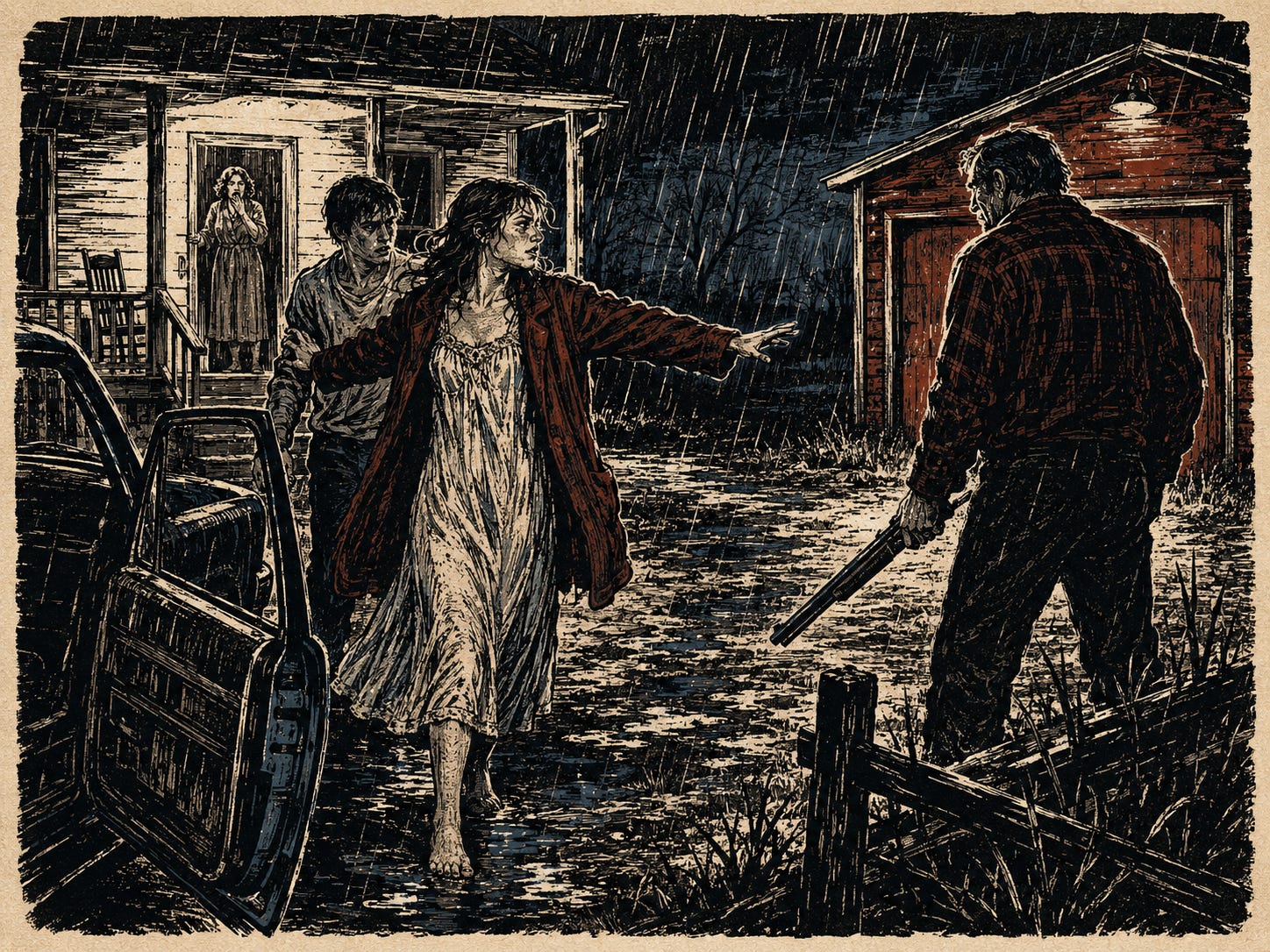
Harlan’s truck was not in the yard when he arrived.
The house had light only in the kitchen and in Lila’s room. The rain had grown a little heavier. Sam stopped hard, left the car door open, and ran.
Lila came out through the side door before he knocked.
She was barefoot.
She wore a nightgown and a coat thrown crookedly over her shoulders. Her cheek was swollen. There was blood on her lip. Her hair was loose, stuck to her face. She ran toward him.
“I told you not to come,” she said.
Not angrily.
Desperately.
Sam grabbed her hands.
“Let’s go.”
“Mom is inside.”
“We’ll come back with the sheriff.”
“We won’t have time.”
“Get in the car.”
Then they heard the truck.
Not far away.
Behind the garage.
The engine roared, then died.
Lila turned her head. Her face changed.
“No.”
Harlan stepped out of the shadow beside the garage.
He was holding a shotgun.
He was not running. That made the scene worse. He walked with the heavy certainty of a man who believes the world still belongs to him even while he is destroying it. His face was red. His hair wet. His shirt open at the neck.
“Get inside,” he said to Lila.
She stood in front of Sam.
“Daddy, put the gun down.”
Harlan laughed.
“He telling you what to say now?”
“No.”
“Get inside.”
“I’m leaving.”
For one second, Harlan looked as if he did not understand her language.
“What did you say?”
“I’m leaving.”
“With him?”
Lila took a breath.
“With my child.”
Harlan raised the shotgun a little.
Not yet toward Sam.
Toward the air.
Like a warning to God.
“There is no child,” he said.
Lila tightened her hand around Sam’s behind her back.
“There is.”
“You will not bring that shame into my house.”
June’s voice came from the door.
“Harlan, please.”
She stood on the threshold, in her robe, hands over her mouth.
No one looked at her.
Sam took one step forward.
“Mr. Brooks, listen to me. We’ll leave. We won’t...”
“Shut up.”
The word came out calmly.
Sam stopped.
“You thought you could come into my house? Take my daughter? Have people laughing behind my back?”
Lila shouted:
“I’m not a thing to be taken.”
Then Harlan truly looked at her.
And in that look, Sam saw something that was not only anger. It was terror. Harlan feared a life where his daughter would no longer remain his child. He feared people would see he had no control. He feared that all his hardness was an empty box.
And because he was afraid, he raised the gun.
June screamed.
Sam heard Lila say:
“Don’t.”
One small word.
Then she moved.
He did not stop her in time.
She stepped in front of him as if it were the most natural thing in the world. The way you step in front of a child so it will not be hit. The way you cover a flame with your hand before thinking it will burn.
The gunshot broke the night.
Birds burst out of the trees.
June fell to her knees.
Harlan remained with the gun raised, his face empty, like a man who had woken up inside his own hand.
Lila fell against Sam.
He held her. He did not understand at first. His body refused. He wrapped his arms around her and lowered her to the ground, whispering no, no, no, as if repetition could put time back.
The blood warmed his hands.
Her face was suddenly very calm. That was the most unjust thing. A person can be dying and look as if they are listening to something far away.
“Sam,” she said.
“Don’t talk. Help is coming. Don’t talk.”
“You’re an idiot.”
He cried and laughed at the same time.
“I know.”
“I told you to run.”
“I couldn’t.”
Lila tried to breathe. Her eyes moved past him, toward her father. Harlan was still standing. June had grabbed his legs and was screaming something that would not become words.
Lila said:
“Daddy.”
Harlan took one step. Then stopped.
“Daddy, don’t...”
Her voice broke.
Sam bent close to her.
“I’m here.”
She looked at him.
“It wasn’t only your fault.”
“We’re not talking about fault right now.”
“We always are.”
She closed her eyes for a moment.
“Would we have gotten married?”
Sam felt something tear inside him.
“Yes.”
“Don’t lie to me.”
“We would have gotten married.”
“Would we have had ugly curtains?”
“The worst.”
Her lips moved like a smile.
“And a baby?”
Sam could not answer at once.
“Yes.”
Lila looked at the sky. Rain fell on her face. She was so young. That was not a thought. It was an accusation against the whole world.
“Tell him,” she whispered.
“Tell who?”
“The child.”
Her voice was almost air.
“Tell him I tried.”
“Lila.”
“Tell him that...”
She did not finish.
Her hand loosened inside his.
For one second Sam waited for her to continue. His body did not understand death. It knew only interruptions, pauses, breaths arriving late. Then he saw her eyes. And there, at last, the dream happened whole.
The sheriff arrived twelve minutes later.
Harlan did not resist. He sat on the ground a few meters away, the shotgun at his side. He kept saying:
“I wasn’t aiming at her.”
No one answered.
June had blood on her hands because she tried to take Lila from Sam and then could not. Sam would not let her go. It took two men to lift him. He did not remember shouting, but they told him he shouted. He did not remember hitting the sheriff, but the skin over his knuckles was split. He did not remember the drive to the station. He remembered only his hands.
Red.
As if he had done something.
The funeral took place three days later.
The church filled with people who wanted to see grief without touching responsibility. Lila was in a white coffin. Her belly did not show. That enraged Sam in a way he could not explain. As if they had made her a girl again so they would not have to admit she had been a woman, that she had life inside her, that she had a decision, that she had a future someone took away and then the world said tragedy so it would not have to say murder, power, shame, father, town, silence.
The pastor spoke about loss.
Sam left before he finished.
He went behind the church, where the garbage was piled and the grass smelled of rain. He bent over and vomited beside a trash bin.
June found him there.
She wore a black dress and gloves. Her face had become stone. Not hard. Stone pulled from a river after years.
“Sam,” she said.
He wiped his mouth.
“I can’t.”
“Neither can I.”
They stood beside the garbage, two people who had failed to save the same girl in different ways.
June took something from her bag.
A small envelope.
“She had it in her drawer.”
Sam did not take it immediately.
“What is it?”
“For you. I think.”
His hands shook when he opened it.
Inside was a piece of paper from the pharmacy, torn from a notepad.
Sam,
If you ever start believing that everything happened because you came, don’t you dare.
You came because you loved me. I did the same when I stepped in front of you.
I don’t know what will happen to us. I don’t know how we’ll live. I don’t know if I’ll be a good mother. I don’t know if you’ll become a good father. We’ll probably make many mistakes.
But I want us to leave. Not from fear. From life.
If I get scared tomorrow, remind me that I said this myself.
Lila.
Sam read the letter three times.
Then he folded it so carefully that June began to cry without sound.
“I should have taken her and left years ago,” she said.
Sam did not tell her no.
He did not say it was not her fault.
There are moments when comfort becomes a lie.
He said only:
“Yes.”
June accepted it like a blow she deserved.
Harlan was convicted.
In court he cried. He said he loved his daughter. He said he had not meant to hurt her. He said the gun went off. He said he had been drinking. He said Sam had made him lose his mind. He said many things. Men like Harlan suddenly find words when their actions ask for an accounting.
Sam did not look at him.
He looked only at his hands.
Then he left Milford Run.
Not the next day. That would have been too clean. He stayed two months. Worked. Saved his money. Sold the car he had driven that night, because he could no longer sit in the seat where her voice still echoed.
He went to the city.
He got a job in a bus repair garage. He lived in a room with a view of a wall. He kept the letter in his wallet, between his driver’s license and a photograph of Lila from the drive in movie theater, back when she had popcorn in her hair and laughter on her face.
Every year, on the same day, he went to a daycare center on the other side of the city and left a box of books. At first he did not know why. Then he understood. He wanted there to be, somewhere, a child who would hold something and open a page. A child who would grow. Not his. Not Lila’s. No one replaces anyone. But life, if you let it, passes through side roads.
In his thirties, he married a woman named Mara, who told him from the beginning that she did not want to live with a ghost without a name.
He told her the whole story.
Not the first week.
Not the first year.
One night, when he heard her laughing in the kitchen and was frightened by how much he wanted to live, he told her.
Mara did not stroke him.
She did not say everything would pass.
She asked him:
“Did you love her?”
“Yes.”
“Do you still love her?”
Sam thought.
“I don’t know if it’s love anymore. It’s something I keep.”
Mara nodded.
“Then keep it properly. Don’t use it to punish yourself every day.”
That was perhaps the hardest thing any person ever asked of him.
Years later, when Sam had gray hair at his temples, he returned to Milford Run for the first time. June was dead. Harlan was still in prison, sick. Roland’s gas station had become an auto parts store. The drive in had closed. The town looked smaller, not because it had changed, but because his fear no longer made it huge.
He went to the cemetery.
Lila’s grave was under a poplar. Her last name was still Brooks. No marker for the child. That used to make him angry. Now it made him tired.
He left two things.
A small box of popcorn from the city movie theater.
And a pair of children’s shoes, white, so small they fit in his palm.
He sat in the grass.
“I didn’t run,” he said.
The wind moved the leaves.
“I still owe you that. I didn’t run.”
He stayed a while.
Then added:
“But I lived.”
The sentence made him cry.
Not because it was forgiveness.
He did not know if such a thing exists.
He cried because for the first time it did not sound like betrayal.
He lived.
Badly on some days. Limping. With nights when he woke before the gunshot. With hands that still felt red. With love that turned elsewhere and did not erase the first. With guilt that did not disappear, but stopped driving the car.
Lila had said, leave not from fear.
Leave from life.
He was late understanding.
Now, sitting before her name, with the sun falling behind the trees and the town making its small noises, he understood something that did not redeem him, but let him breathe a little better.
Not everyone we love is saved.
Sometimes the only thing left is to not let their death become their final sentence.
Sam stood slowly.
He placed his hand on the stone.
“I’ll say you tried,” he whispered.
Then he walked toward the exit.
He did not run.
He no longer needed to.
The night was not chasing him that time.
It only followed from a distance, like something old that had finally lost its voice.
Hi Lyrics,
Don't Come Back means this to me: sometimes we believe we would not have chosen to survive the loss of someone we loved. It is too much to bear. And yes, there is often so much residual guilt it is almost more difficult to survive than the loss itself. But our reason to survive, the reason we must choose to survive, is embodied in these lines:
"Not everyone is saved. Sometimes the only thing left is to not let their death become their final sentence."
When their loss feels so monumental that we feel life is too painful to bear, all we need remember is that even if we don't choose to live for our own sake, we owe it to live it for the one we loved who was lost. Because what you wrote it true. If we're no longer here to remember them, then death will indeed become their final sentence.
This story is beautiful, Lyrics. I am so glad I had the opportunity to read it with the attention and devotion it deserved this morning.
What stayed with me was not the gunshot, but the weight of surviving after the moment itself has already ended.
This story understands something difficult: grief does not move in a straight line. It settles into gestures, into objects, into the way someone keeps living long after meaning has collapsed.
The ending does not try to redeem the past or purify it. It simply lets life continue carrying what cannot be repaired, and that is exactly why it feels real.