
At 3:17 (From my old notebook)
A smoke-soaked night story about desire, alcohol, and the moment a man realizes the voice haunting him is not asking to return, but forcing him to finally stop waiting in the ashes

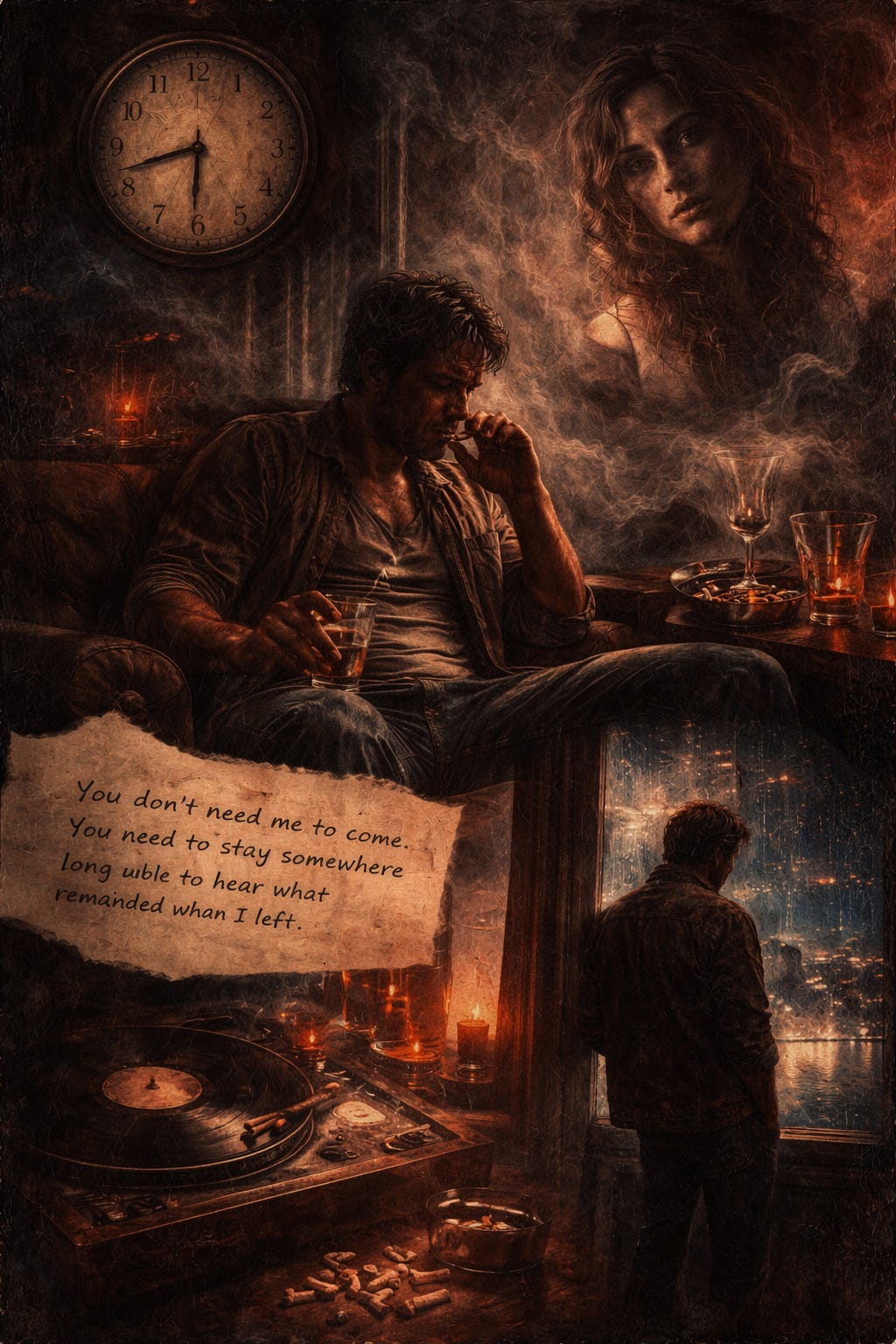
The clock on the wall had stopped at 3:17.
Or at least that was what Martin wanted to believe, because the other version was worse. That the clock was working perfectly well and that he was the one who had gone wrong, badly enough that time no longer moved inside him, only outside him. The room was half dark. The television was playing without sound, images from some late-night talk show, mouths opening and closing, laughter that never arrived, people made of light and nothing. On the table sat a half-full glass of whiskey and an ashtray overflowing with cigarette butts, ash, and all the small burned proofs that the night had already lasted too long.
Martin was sitting in the armchair with one leg tucked under him and his shirt open at the throat. His apartment smelled of alcohol, stale air, smoke, and that bitter scent old records and damp rooms acquire when they are no longer exactly inhabited by a person, only by his routine. He lit another cigarette. The match briefly illuminated his hand, the veins in it, the thumbnail yellowed by years. Smoke rose slowly, as though performing some ritual.
“Why don’t you ever come when I want you?” he whispered.
He did not say it loudly. There was no one there to hear it. Or maybe there was, and that was the worst part.
Her voice came the way it always came. Without warning. Calm. Clear. As if no time had passed, as if no abyss existed between the room and whatever had once been real.
“Maybe because you don’t want me. You want the emptiness I leave behind.”
Martin laughed with that small dry laugh of people who no longer have enough strength for proper irony.
“No,” he said. “I want the voice that cracks. The breath before you speak. I want that moment when everything is about to happen and then nothing does.”
He stood and walked to the window. The city lights trembled on the glass. The glass was dirty. Outside, somewhere far off, an ambulance passed without ever being seen, only its light sliding briefly across the buildings opposite. The night spread over the rooftops like a heavy cloth.
“I want a storm to come,” he said, “and scream everything we never said. Everything we were too afraid to see.”
Her voice did not soften. “It’s not the weather’s fault. You always wait for something to drown you so you can feel alive.”
Martin rested his forehead against the window. The cold helped for half a second. “Maybe,” he said. “Maybe I need something that breaks. Something that burns all the way to the sun.”
Silence fell for a moment. Not absence. More like it had stepped back to gather force.
Then her voice came again, lower.
“You always ask for fire. And when you find it, you run to save yourself.”
Martin closed his eyes. There it was, all of it, ugly and clear. He had not only loved the woman. He had also loved the terror she woke in him. He had loved the point just before destruction, not the life that follows it.
Her name was Elena. She was five years younger than he was, painted badly but with nerve, laughed just before turning serious, and had that look some people have that tells you if you let them, they will see the whole room, the whole lie, the whole rehearsal you are putting on, and they will say it out loud. He met her in a bar with red lights, wrong music, and a friend who later disappeared into cirrhosis or debt, it no longer mattered which. Elena smoked more than he did then and drank whiskey without ice. On the first night she told him, “You have the face of a man who’ll take me home and then hate me for staying.” He laughed. She did not.
They were together for four years.
Not quietly. Not cleanly. With interruptions, returns, bodies that knew how to find each other again before words could decide whether they should. Elena had been the first woman who did not admire him because he was dark. She grew tired of him for that. And even so she loved him. That was what made him fear her worse.
“And you,” he said now into the half-dark, “you always left just before I struck the match.”
She almost smiled inside the sound of her voice. “No. I left when I understood you were going to burn the room down again just so you could later write about how beautiful the ash smelled.”
Martin turned away from the window and looked around the room as if seeing it for the first time. The couch with the blanket thrown over it. The chair with his jacket. The record by the turntable that had not been played all the way through in years. The ashtray. The cigarette butts. The glass. Everything looked like a set after a performance no one had bothered to dismantle.
He walked to the turntable, lifted the record carefully from its sleeve, and lowered it under the needle. The needle scratched before it found the groove, and that sound felt to him more honest than any song that would follow. Then came piano. Hesitant. As if waking from years of sleep.
“You know,” he said, “the drink became my bridge. From imagination to nothing. From you to you.”
Elena did not answer at once. When she did, her voice carried something almost tired now. “And what do you find there?”
Martin picked up the glass, held it to the light of the screen. “Ice. Snow. The illusion that I still exist. Every sip burns me and freezes me at once.”
“Why don’t you stop?”
“Because then I’d hear you.”
Silence.
“And I’m afraid of your voice when you’re not here,” he said at last.
That was the closest he had come to the truth without poetry. Which was why the room seemed to shift temperature for a moment. Elena was not exactly a ghost. Nor exactly memory. She was the form absence had taken inside him because he had never let it die properly. He had lost her three years earlier. Not through death. Through something more human and more shameful. He lost her because every time she got too close, he started drinking more, saying less, growing ironic, looking elsewhere, opening small fractures until he could later pretend the relationship had simply ended on its own.
Their final night had not involved screaming. These things do not always end with shattered glasses. Sometimes they end far more quietly, and that quiet follows you longer.
Elena had stood in the doorway with her coat in her hand. “I’m not leaving because you don’t love me,” she had said. “I’m leaving because you only love me when you’re hurting. And I can’t be your knife.”
He did not stop her. That was his worst crime. Not that he hurt her. That he understood she was telling the truth and still remained still.
Now he stood inside a home that had become a museum of postponement, speaking to a voice that was perhaps as much his own as hers.
“You don’t come because I never let you leave,” she said, as if reading his thoughts. “You’re a prison made of desire. And I’m a shadow fed by your silence.”
Martin drank the rest of the whiskey in one swallow. It burned his throat. His stomach. Somewhere much deeper.
“Then build a bridge,” he said. “From the temple of my soul to the brothel of my life. So you can come, or I can go.”
The sentence remained in the room for a moment. It could have been ridiculous. It could have been drunken nonsense. It was both. But it was also the only language he knew. To dress the raw thing in image, because if he said it plainly he would have to survive it.
The music swelled a little. The piano finally found its melody. Her voice vanished.
Martin stood in the middle of the room. The clock still showed 3:17. The television still flickered without sound. The ashtray still overflowed. He stared at the ash as if he genuinely expected something to rise from it. Something new. Something not identical to all the other nights.
Nothing.
That was the punishment. Not in the intensity. In the repetition.
He went into the kitchen, poured himself another drink, but did not swallow it right away. He left the glass on the counter. Opened the cupboard. Took out the cigarette pack. Looked at it. Put it back. The gesture felt briefly enormous to him, as if he had refused not tobacco but an entire route.
He returned to the living room and sat again in the armchair. The music was still playing. The record had begun warming the air. His eyes fell on the shelf of old folders. Elena had once left sketches there, bills, a photograph, a letter he never opened. He got up, opened the drawer, found the folder. Her handwriting was the same. Nervous but clear. He sat down and finally opened it.
Inside was a single sheet of paper.
You don’t need me to come. You need to stay somewhere long enough to hear what remained when I left.
He read the sentence once. Then again. The needle reached the end of the record and began tapping rhythmically in the empty groove, a small metallic pulse.
The clock still 3:17.
Something broke then, but quietly. Not like catharsis. Like acknowledgment. Martin laid the letter on the table, took the glass, and poured the whiskey down the sink. Then he opened the window. Night air came in, cold, dirty, real. The city could finally be heard, far away, indifferent, alive.
He came back, stood beneath the clock, and looked at it closely. A thin layer of dust over the glass. He took it down from the wall. On the back, the battery was dead. That simple.
No metaphysics. No curse. No frozen time.
Just a dead battery no one had changed.
He held the clock in his hands and laughed so bitterly it almost became a sob. There it was, then, he thought. That was most of his life too. Not fatal drama. Just the abandonment of small things until the whole house began to look haunted.
He set the clock on the table. Turned off the television. Let the room lose its pointless blue glow. The silence changed texture immediately. It no longer carried her voice inside it. It carried his.
He stood still for a moment.
Then he whispered again, softer than the first time, but no longer as complaint.
“Why don’t you ever come when I want you?”
And this time he knew the answer before any voice returned.
Because she was not the one who needed to come.
He was the one who needed, finally, to leave the burning, the drinking, the ash, and go toward the place where things do not speak through ghosts but through cost.
He remained standing in the room that still smelled of smoke, alcohol, and waiting.
But for the first time, waiting no longer felt like ritual.
It felt like a beginning.
good read
You could almost smell the whiskey in his glass. well done